The Spiritual Centre.co.uk
Presences of the Living Landscape
Across the Celtic lands the world was never seen as empty. Forests, rivers, hills and springs were understood to carry presences that moved within the same breath of life that sustains mankind, animals and trees. These presences were remembered as totems, guardians, spirits and deities. Some were vast and ancient, known across entire regions. Others were local companions tied to a spring, a grove, or a standing stone.
Within this tradition the trees of the Ogham were not simply plants rooted in soil. Each tree existed within a wider field of consciousness that included animals, spirits, and the unseen intelligences of land and water. These presences do not replace the trees. Rather, they move alongside them, shaping the stories, symbols and spiritual relationships that have grown around each tree for centuries.
In the language of The Spiritual Centre, all of these presences participate in the same current of Bnwyfre, the breath of life and life force energy that animates all living things.
Totems, Spirits and Sacred Presences
Some entities remembered in Celtic tradition are clearly divine, such as Sulis of the sacred waters or Rosmerta who embodies provision and abundance. Others appear in folklore as teachers, protectors or threshold figures who guide the human imagination toward deeper understanding.
These presences should not be approached as rigid dogma. Celtic tradition rarely worked that way. Instead they act as symbolic companions to the trees. When a person approaches a tree for reflection, healing, or spiritual insight, the totems and entities associated with that tree help illuminate the deeper qualities held within its nature.
In this way the trees remain the centre of the teaching, while the totems and entities help reveal the personality, mythology and wisdom that surrounds them.
Celtic Totems and Entities
Totems and Entities Index of the Ogham Trees
The totems and entities presented here have been alphabetised for ease of reference, no hierarchy or implied entitlement is intended.
Arch-Angel Gabriel x 2
Cernunni x 3
Crone x 2
Cwn Annwn
Druantia x 3
Dryads x 2
Elementals
Fairies - Fae - Sidhe x 2
Faunus
Green Man x 3
Gnomi
Hesperides x 2
Hildegard of Bingen x 2
Holly Queen x 2
Hugginn and Mugginn x 2
Joseph of Arimithea
Magdalene
Maidens
Maponos
Meliae
Naiads
Nodens
Nymphs
Old Hag
Pan
Rosmerta
Pan
Paracelsus x 2
Sucellus
Sulis
Within Celtic tradition many presences appear in stories, ritual memory and folklore. Some are gods, others guardians of place, while some exist in the shadowed borderlands between myth and spirit.
Well Maiden
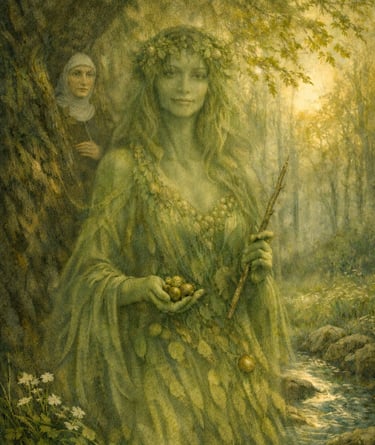
White Lady of the Woods
Totems and Entities, Gateway to the Ogham Trees
1st Aicme - (Beith)
2nd Aicme -(Huathe)
3rd Aicme - (Muin)
5th Aicme - (Forfeda)
4th Aicme (Ailim)
Reed - (Ngetal)
Fir - (Ailim)
Grove - (Koad)
Honeysuckle - Uilleand
Elder - (Ruis)
Gorse - (Ohn)
B/Thorn - (Straif)
Yew - (Ioho)
W/Poplar - (Eadha)
Sea - (Mor)
Heather - (Ur)
Spindle - (Oir)
Beech - (Phagus)
This section is a work in progress check back soon to see latest updates: Last updated 08-03-2026
Arch-Angel Gabriel
Archangel Gabriel
Gabriels Hounds - Cwn Annwn - Archangel Gabriel is believed to appear at the end of days, serving as a companion for the soul as it transitions into the afterlife or otherworld. Gabriel's hounds offer solace, safety, and comfort throughout this journey. It is Cwn Annwn that originates from Celtic legend and should not be confused with other interpretations.
Archangel Gabriel
Archangel Gabriel is the celestial messenger from the divine. In our hour of need, when we reach for help to trust in moving forward, we can rely on Gabriel to convey messages of hope and lead us from despair to enlightenment.
Cernunni
Cernunni are described as a hybrid species, possessing both human and deer characteristics, originating from the deity Cernunnos in the ancient woodlands of Britain.
They ventured out from Britain across the northern hemisphere, establishing groves for their followers. Samhain is a time of new beginnings, a time for fertility, fecundity, gathering and sharing resources. The summer solstice is a time for birthing and creating new life, new beginnings.
The interval between conception and birth parallels that of humans, with the summer solstice representing an optimal period for new life due to the abundance of food.
This same rhythm is reflected within the Birch Tree, associated with conception and early beginnings.
The Alder Tree, aligned with gestation, growth, and the transition toward birth.
Crone (Hylde-Moer)
A crone is a mystical figure, a woman beyond childbearing years, the wise woman of the village, the healer with remedies for all ailments. She is a lonely widow who is feared by small children, avoided by mothers, and befriended by those seeking healing or in need.
She is said to guard the Elder tree, protecting its wares and cursing those who infringe on her space without respect. Hylde Moer is a name she will answer to, but she is the third aspect of a maiden, mother, or crone and will answer any request.
The crone, an unseen sentinel, maintains peace, fosters harmony, and freely bestows her blessings. At all times in a girl's life when guidance is sought, the Crone can be found waiting, ready, and anticipating her needs.
(See: Hazel Tree - Crone encourages the end for new beginnings)
Cwn Annwn
Cwn Annwn is traditionally acknowledged as the pack of hounds that leads the hunt during Samhain, signalling the end of autumn and the final gathering of supplies before winter. They are also recognised, as they accompany souls to the domain of Annwn. They serve as a wellspring of various legends and fables, encompassing spectral canines that howl into the night – said to be the last sound one will hear – and loyal companion dogs that accompany deities in their duties, perpetually vigilant over their masters.
Archangel Gabriel is believed to appear at the end of days, serving as a companion for the soul as it transitions into the afterlife or otherworld. Gabriel's hounds offer solace, safety, and comfort throughout this journey. It is Cwn Annwn that originates from Celtic legend and should not be confused with other interpretations.
It is said the nine hounds of Cwn Annwn are also known as Gabriel's hounds, linked only through familiarity of the two legends, history and legend coming together. The nine hounds are also said to occupy the positions of the spirit guides that surround us.
1) Above - 2) one in the north - 3) one in the East - 4) South - 5) West - 6) left shoulder - 7) Right shoulder - 8) Heart - 9) one below.
Druantia
Druantia is the queen and ruler of the Dryads, the earth elementals inhabiting the trees. Her abode is the fir tree, particularly the ancient Scots pine: the austere and harsh realities of the Highlands establish her majesty over all terrestrial elementals that inhabit Gaia, including the dryads, of which she is one.
Her presence is intertwined with the very essence of nature, granting her the power to nurture and protect the forests, the dryads and all of Gaia's elementals. Druantia moves with the seasons, changing with the wind in each direction until returning to the north.
Spiritually, Druantia represents guardianship and balance. She stands at the meeting place of growth and restraint, reminding us that true flourishing requires limits, seasons, and respect for natural order. Her energy is protective yet nurturing, encouraging reverence for the living world and responsibility for what we tend. Under her watch, forests are not resources but relationships.
Druantia is a mother that sees the transition from maiden to crone, the old maid. Ever watchful, ever joyful, Druantia hides within the folds of the hawthorn and is the steady hand of guidance as the young maid matures.
Dryads
The Dryads, enchanting earth-tied entities, have a rich and fascinating origin that traces back to the majestic oak tree. These ethereal beings are more than mere figments of folklore; they embody the very spirit of nature itself, intricately woven into the fabric of our forests. Initially believed to be solely associated with oak trees, Dryads eventually evolved to represent the broader essence of tree spirits, embodying the life force that pulses within all wooded realms.
Dryads are linked to oak trees, from which they spread to other groves and individual trees. Ask a child to draw a tree, and they will draw a person made of twigs and sticks. "Never is a truer word spoken than that from a child." Today's society often sees the dryad as a stick person among trees.
Dryads are elementals of the earth, also known as the 'gnomies'; they vary in height and can grow as tall as five feet in height. Their natural state is that of twigs and sticks, and they can often be seen playing near the trunks of trees or in the shadows of a copse or glade. Sitting under the tree in good spirits will encourage the dryads to appear as human females of your persuasion or as a pleasing image. Their objective is harmony, to be able to enhance or complement the essence of your aura. Permitting them to communicate with you first, in their own way, will lead to successful communication.
Sitting under the tree in good spirit will encourage the dryads to appear as an image of your pleasing with their objective being harmonious to you. To be compatible with your energy and to be able to enhance or complement the essence of your aura. Permitting them to communicate with you first, in their own way, will lead to a more successful communication.
In the literal sense, Dryads are tied to the oak tree. In a broader sense, dryads are earth-tied elementals that may share other elements with the Sylphs (Air), Salamanders (Fire), and Undines (Water); these concepts can be broken down further if we look at individual trees.
The apple tree and orchard are naturally attractive to Hesperides in the autumn, to look west through an orchard of golden apples, and they can be seen playing in the shadows in the twilight hour as day turns to night.
The ash tree is home to meliae, water nymphs from the fresh waters and streams that adapted and shared their harmony.
Druantia is queen of the dryads, and yet she resides in the fir tree and oversees all of the trees of the forest.
Holly Queen resides predominantly in the dark half of the year, with the holly tree being her place of residence. She favours the salamanders and has been known to encourage Furze to ignite for them and shares festivals with them.
The objective of the dryads is harmony; to reduce them to singular values or purpose is wrong.
Elementals
Elementals, including mankind, can be categorised into three species: terrestrial (of the earth) celestial (of the heavens) and Extra-Terrestrial (not from Earth)
The terrestrial species can be broken down into a further six:
Mankind = Human
Gnomi = Earth
Sylphs = Air
Salamander = Fire
Undines = Water
Spiritual Incarnates = elementals conscious of others.
Mankind = Terrestrial elementals that reside within the density of physical reality.
Gnomi = Earth elementals reside within the earth; just as we rely on air for respiration, these elementals depend on the earth and its solid state.
Sylphs = Air elementals are identified in clouds, the mists of dawn, or vapours from ascending warm air currents. These entities are present in narratives of the Fae, fairy folk, and angels; they rely on wind and air currents for sustenance. A common description is one of transparent creatures that can be seen in the peripheral vision.
Salamander = Fire elementals can be identified in the flames of a fire and the burning embers that remain after the fire. Occasionally they can be seen in a storm-ravaged sky seeking their place on earth. They can be seen in the image of the flame and survive in the etheric body attracted to a flame. These elementals bring calm to their surroundings; they burn incompatible energy and replace it with energy that bestows peace. In the past, the dance of these elementals mesmerised people as they gazed into the heart of a fire. A single candle in a room can encourage the 'fire elementals' to do their work. A common description today is of yellow wisps that turn orange when seen, then turn blue and disappear.
Undines = Water elementals are identified in it. The oceans and seas contain a different elemental to the inland elementals of the rivers and streams. The elementals from the ocean are much larger than their inland family and more human-like in both physical and emotional capacity, with the general perception of the mermaid being a classic example. Water elementals are our closest allies; a vast majority of them can see us and are aware of our presence. Once we are aware of their presence, they will encourage communication. A common description today is the mermaid; most people are unaware of their presence within the indoor water feature. Mermaids are usually perceived as female and adult-sized; if they were perceived as 'nymphs', miniature mermaid-type entities, they would have much wider general acceptance.
Inland water elementals are of a much more gentle nature than their oceanic relatives. 'Mermaid' is an adequate generalisation that describes both sexes. Their degree of transparency depends on personal choice and the viewer's perception capabilities. The essence and romance of a babbling brook, a water fountain, and the gentle sound of rippling water will contribute to the elementals making themselves known. Believers and beings who possess a sense of spiritual acceptance are more likely to see them than those without a sense of spirituality.
Spiritual Incarnates are elementals made in God's image; these beings live in harmony with all other elementals and can be socially aware of one or more of them.
Their role reflects balance, consciousness, and integration within the wider elemental field, a quality also associated with the Alder Tree, which stands at the threshold between worlds and supports connection, gestation, and relational awareness.
Extra-Terrestrial are beings not from Earth. But it is worth noting their origin is assumed to be other planets, it is possible there are other origins.
Fairies - Fae - Sidhe
The fairies, fae, and sidhe are part of the community of sylphs and gnomi that support our growth and enable us to perceive the world beyond mere physical reality. Whether they are earth-bound gnomes or air-bound sylphs, the fairies occupy their rightful place within the realms of the elementals. Gnomes, elves, and angels coexist alongside them in their own distinct realms.
The fairies, the Fae, and the Sidhe are earth-tied elementals that gather in specific locations, allowing other earth-tied elementals to perceive them at these places. The hawthorn tree serves as one such portal into the faerie realms, where children can see and converse with them.
When a child names a fairy, that fairy will come when called; the name serves as a portal through which the fairy can travel. However, this portal may collapse due to lack of use, though it can be re-established decades later through good intent and belief.
See: Hazel Tree - awareness
Faunus
Ancient Guardian of the Italian Woodlands
Faunus is one of the oldest nature deities of ancient Italy, honoured by the early Latin peoples long before the rise of the Roman Empire. He belongs originally to the rural religions of central Italy, where farmers and shepherds recognised him as a protector of forests, grazing lands and wild countryside. In these early traditions Faunus watched over animals, fields and the natural rhythms of the land, ensuring fertility among flocks and harmony within the landscape.
As Roman culture expanded, Faunus became known throughout the wider Roman world and was sometimes compared with the Greek woodland god Pan because both shared similar connections with wild nature, animals and pastoral life. Despite these later associations, Faunus remained fundamentally an Italic deity rooted in the ancient countryside of Italy, closely tied to woodland groves, hills and rural valleys rather than cities or formal temples.
In this quiet exchange between nature and awareness lies a form of natural healing long recognised in ancient traditions. Just as the temples of Asclepius welcomed seekers into restorative sleep, the groves of Faunus were places where the mind softened and the body returned to balance through stillness and listening. The whispers of wind through willow and reed, the gentle movement of water and the distant tones carried through hollow stems recall the music of Pan, whose reed pipes turned breath and landscape into healing sound. In such environments the rhythms of the land itself become restorative, allowing the subtle current of Bnwyfre, the breath of life and life force energy, to move freely through body, mind and spirit.
During the Roman presence across Europe, including Celtic territories, Roman and local traditions often met and influenced one another. In some regions figures such as Faunus were recognised alongside native nature spirits, and their qualities occasionally overlapped with those of Celtic guardians of forests and animals. For this reason he may appear within broader nature traditions beyond Italy, not as a Celtic god in origin, but as a related spirit of wild landscapes whose symbolism resonates across different cultures.
Within the wider study of nature spirits and totems, Faunus represents the vital presence of woodland and untamed countryside, a reminder that forests, animals and the open land carry their own living awareness. Through these natural landscapes flows Bnwyfre, the breath of life and life force energy, sustaining the harmony between earth, creature and spirit alike.
Reed / Faunus
Spirit of the Reed Lands
Faunus, the ancient woodland spirit of early Italy, belongs naturally to the quiet boundary landscapes where Reed grows along rivers, marshes and wetlands. Although Roman in origin, his symbolism of wild nature, animals and pastoral life resonates in these gentle places where water, wind and wildlife move in harmony. Within the Reed landscape creatures such as the Salmon, travelling the river with ancient purpose, and the Frog, moving easily between water and land, reflect the same living vitality that Faunus represents. Ancient traditions also linked him with dreams, intuition and the subtle voice of nature, believed to be heard in the wind moving through trees and reeds. In this way the reed beds become places of quiet restoration and reflection, where the rhythms of the landscape encourage balance and renewal through Bnwyfre, the breath of life and life force energy flowing through all living things.
Gnomi
The Gnomi arise from the deep places of Earth — from stone, root, and the long patience of soil. They belong to the North, the quarter of the compass that represents Earth, foundation, and enduring stability. In this direction the land is not simply ground beneath our feet but living presence, the ancient body of Gaia, known in Greek tradition yet recognised across many lands and peoples since time immemorial.
Within Celtic land-awareness this same living Earth has long been honoured through the sovereignty of the land itself — the spirit of place, mountain, and soil that sustains tribe and forest alike. The Gnomi dwell within this depth of land-consciousness, close to root and mineral, shaping the hidden processes through which life emerges. Their influence is rarely seen, yet it is constant: guiding germination, holding the structure of landscape, and maintaining the balance beneath the visible world.
Moving through Bnwyfre — breath of life and life force energy, the Gnomi participate in the enduring rhythm of the Earth itself. Their nature reflects patience, resilience, and grounded awareness. Like the ancient hills of the North, they remind us that true strength is rarely hurried; it is formed slowly, through time, pressure, and continuity.
The Gnomi teach that beneath every forest, field, and mountain lies a deeper intelligence. The living Earth — whether named Gaia, the land of the Celts, or simply the ground that sustains us — continues its quiet work, supporting life through ages beyond memory.
Green Man
Green Man (Oak King) is documented in his many guises across the northern hemisphere and dates back to the Bronze Age and the rise of the Celts. Engraved in the Gundestrup Cauldron, he has sealed his place in history.
Cernunnos, Perkunas, and Taranis are names by which he is associated with, across Britain, Gaul, the Balkans, Greece, and Rome. He can live for over 2,000 years and has given rise to numerous legends, myths, and urban stories.
The Green Man (Oak King) is the personification of the oak tree. Within the Celtic culture, it is often linked to Jupiter, the largest of the five watchers in the summer sky. The green man is often associated with scarecrows, with images placed in fields to keep the crows away. There is an element of truth in that with the owl in residence, crows won't come close, and so the legends associated with oak begin. The oak is often depicted with a hand held high, reaching up into the storm; the oak can be struck by lightning and continue to grow; an ancient oak (700+ years) is often hollowed.
The year is divided into two halves: the Oak King rules from the winter solstice as the days grow longer, and at the summer solstice, after the longest day, he surrenders the crown to the Holly Queen, who will then rule until the next winter solstice. She governs from the shortest night to the longest night, at which point she will return the crown to the Oak King.
Oak Tree is home to the Green man among other dryads
Hesperides
The Hesperides are the blonde-haired, golden-skinned keepers of the orchard. It is the golden apples that preserve immortality; the Hesperides dance in the evening twilight, encouraging life force energies into life, love, and harmony. The bridge between this life and eternal life lies in the secret of love.
The mortals become immortal, as they travel towards the sunset to be met by the Hesperides dancing into the night and removing the obstacles that the pathway of life presents.
Stand at the top of 'The Tor' and gaze towards the sunset; looking across the rivers and mists of Avalon, the Hesperides can be seen dancing, the unicorns in attendance, and the holly queen is present overseeing this nightly celebration of life in the autumn months.
Look into the rivers, look up into the stars; Ladon can be found guarding this domain.
Hildegard of Bingen (1098 - 1179)
Hildegard of Bingen was a 12th-century German Benedictine abbess, mystic, visionary writer, composer, healer, and natural philosopher. She is best known for her theological visions, her concept of viriditas (the greening life-force of creation), her sacred music, and her writings on herbal medicine and natural healing.
She operated within the Christian monastic tradition yet explored cosmology, medicine, ethics, music, and the natural world with remarkable breadth. In 2012 she was formally recognised as a Doctor of the Church, affirming her theological significance.
In 1150, as Hildegard of Bingen established her independent convent at Rupertsberg near Bingen, she entered the most fertile period of her visionary work, composing her great theological texts and shaping what she called the Lingua Ignota, an “unknown language” of over a thousand invented nouns accompanied by its own alphabet. This sacred vocabulary was not designed for common speech but for naming realities she believed lay beyond ordinary Latin: hierarchies of heaven, virtues, forces of creation. In this, her work quietly mirrors Ogham, the tree-script of the Celtic world. Which likewise encodes cosmology within structured signs. Both function as threshold languages: Ogham rooting meaning in the living landscape of woodland, forestry and Celtic Tree Lore; Hildegard’s lexicon rooting meaning in visionary order and viriditas, the greening life-force. One rises from forest inscription, the other from cloistered revelation, yet each forms a bridge between visible and invisible order — systems of encoded harmony that speak to Bnwyfre as breath, structure, and living intelligence moving through word, tree, and world alike.
Hildegard’s concept of viriditas — the greening vitality of divine life moving through all creation — aligns strongly with Hazel’s current of ripened understanding. Hazel does not represent explosive revelation; it represents cultivated discernment, insight gained through contemplation, and wisdom gathered and offered.
Where Hazel holds the nut of knowledge, Hildegard held vision refined through prayer, observation, and disciplined thought.
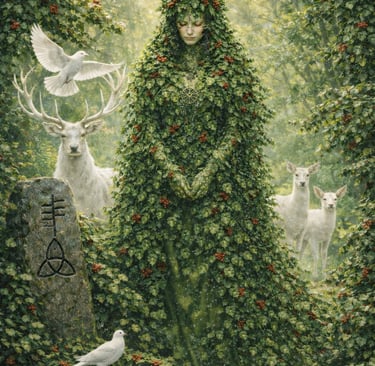
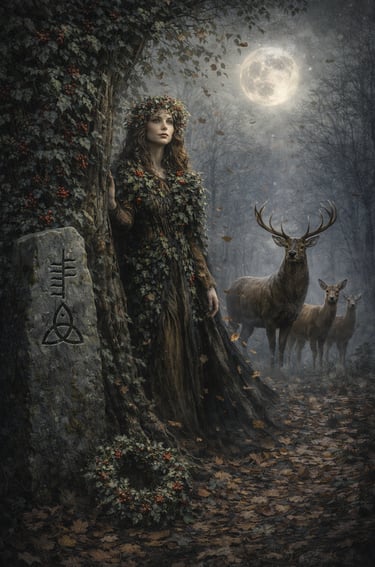
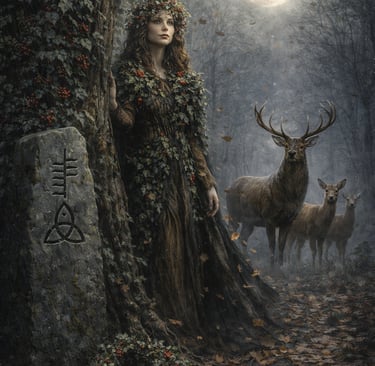
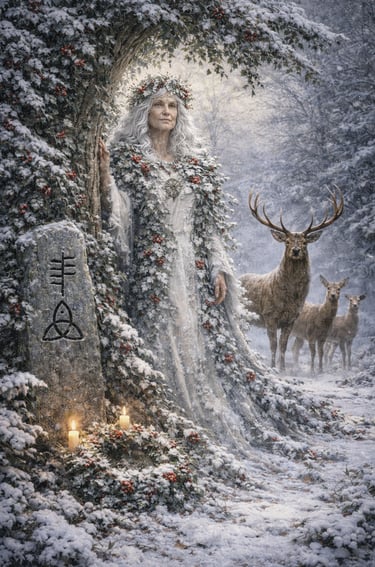
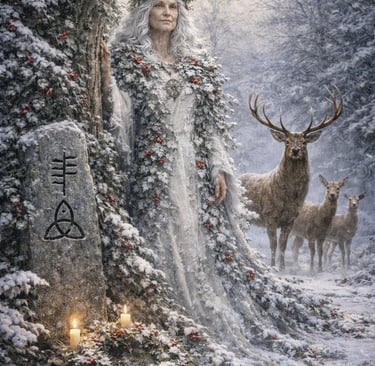
Holly Queen
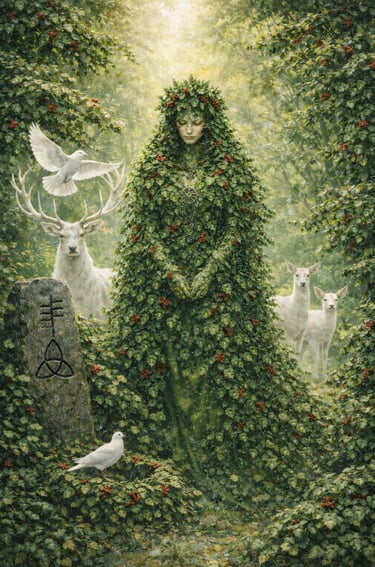
Holly Queen, a figure of enchanting beauty and grace, inherits the monarchy at the Summer Solstice and holds it all the way to the Winter Solstice, marking her reign over this vibrant dark half of the year. She is not merely a monarch emerging from isolation; rather, she serves as the ideal counterpart to the Oak King, who wears his crown from the Winter Solstice until the arrival of summer's warmth. Together, they embody a harmonious balance within nature’s cycle, each one illuminating and enhancing the other's strengths.
Their likeness is such that she is also known as the scarlet oak, the vibrant hues coming from glistening berries in abundance at the time she relinquishes her crown to the oak king. It is the harsh frost, the coldness of winter, and the purity of the snow that encourage her berries to soften, shine, and glow so red they are almost purple. It is this scarlet hue that empowers her and brings her to her prime. It is with humility and respect that she relinquishes her crown to the Oak King so that he can once again extend the days and inherit the throne.
The energy or essence of Holly takes time to acknowledge; her energy can be likened to that of the energy of a butterfly wing; it is only after experiencing it that it can be accepted. It is after acceptance that the unicorn and sacred white eilidh will appear as your guides.
The quietude surrounding her presence whispers secrets of tranquillity, the kind that invites introspection and wonder. Imagine inhaling deeply; you would catch hints of moss mingling with damp earth from an enchanted grove where ancient trees stand sentinel over timeless stories yet untold. To behold Holly Queen in her full splendour, one must journey westward and cast their gaze eastward towards lush holly bushes adorned with glimmering red berries. If you are fortunate enough, you may just glimpse her watching over you with eyes that hold centuries' worth of wisdom. However, approaching her directly is forbidden; instead, she requires those who wish to encounter her to open themselves up fully, to be present in spirit and mind. When your heart aligns with nature’s rhythm, she will come forth when destiny deems it right.
Rowan Tree - Holly Queen share the winter solstice.
Huginn and Muninn
Huginn and Munnin
Huginn and Muninn, the wise ravens of Norse mythology, are sent out each morning from the ash tree at dawn to soar across the vast expanse of the world, returning each evening to their master, Odin. These two feathered companions are not merely birds; they embody profound concepts, memory, and thought. With their flights, they gather knowledge from every corner of the earth and bring back insights that illuminate a troubled mind with clarity and understanding. Their presence serves as a reminder of the importance of reflection and wisdom in our lives.
The Ash Tree, long linked with memory, world-awareness, and the connective axis between realms.
The Ravens - Huginn and Munnin
Bran the river man and Beli Mawr both had Ravens as the emblem on their flags. A Raven in flight or Raven basking in the dirt on a summers day, with five feather tips stretched out like fingers they own the day with a majesty few can uphold. In flight they can be seen for miles frequently with crows as escort, in the dirt bath and basking in the sun with wings outstretched, they do so without fear. With majesty and a sense of entitlement few are able to muster. Did Huginn and Muginn serve the Celts as they served Odin?
Joseph of Arimathea
Joseph of Arimathea is the man who asked Pontius Pilate for permission to remove Jesus' body from the cross.
He is the individual who, when Jesus was just seven years old, brought him to Britain to escape the tumult of Jerusalem.
Additionally, he orchestrated Jesus' escape after the crucifixion and facilitated a safe voyage to Britain.
Joseph of Arimithea on arrival in Glastonbury, threw his staff into the ground at Wearyall Hill and used it to get out of the boat. When Joseph returned the next day to retrieve the staff, he found that it had bloomed into what we now know as the Glastonbury Thorn.
Following the baptism of James, the son of Jesus, he arranged for the baptism of 1,800 soldiers before they went into battle under Boadicea's leadership.
He is also acknowledged as the founder of the first Christian church in Britain.
Joseph of Arimathea had many interactions with the Druids, so much so they were established trading partners and friends. Joseph was a respected elder within the Jewish communities; the exchange of information and meeting of minds between him, the Druids and the High Priests of Briton was beneficial to their respective audiences. Joseph introduced Jesus to the Druids and later entrusted him into their care. 'Jesus's missing years' were spent with the Druids in Briton and also the monasteries in India.
Magdalene
Magdalene energy embodies the feminine essence that originates from the soul of the divine. It represents a maternal force that only needs to be recognised once, yet it offers a lifetime of intuitive maternal qualities.
It is most commonly associated with Mary Magdalene, yet it is frequently overshadowed by the figures of Jesus and Mother Mary. Furthermore, Magdalene energy is often too subtle to be fully appreciated; it requires a sensitivity that is frequently lost within the density of today's busy society.
The utterance of 'OM' and the majestic act of clasping hands in a prayer-like manner serve to summon the energy of Magdalene. In this image, Mary Magdalene is portrayed as a veiled princess of olive skin, embellished with white lace and silks beneath a hooded cloak. Her presence conveys her grandeur in a humble and modest manner.
Maidens
The maidens drawn to the ash tree emerge from every corner of existence: fae, nymphs, meliae, gnomies, sylphs, undines, humans, and celestials, the angelic beings of the divine. They gather during the twilight hours, comforted by the flickering shadows that deepen with the night, recede with the day, and linger in the enchanting mists that obscure and elongate the moments of their being.
The meliae are nymph maidens from the rivers, streams, babbling brooks, and inland waters of the Celtic lands. They emerged from the waters and married a dryad, setting up home in the ash tree.
Julius Caesar is said to have tied a maiden to the ash tree under the gaze of a full moon in order to lure a unicorn into a trap. Upon failing to attract the unicorn, the maiden's virtue was questioned, and she was put to death.
The triple goddess embodies the maiden, mother, and crone; it is the essence of ash that facilitates their convergence into a singular entity, fostering harmony in the environment, encompassing birth, life, and death, the perpetual cycle of all life.
Maponos
The old people of the coast used to say that Maponus walks the Durham cliffs before anyone sees him. They said he comes in on the wind at Seaham, long before spring shows its face, when the sea is still iron-grey and the gulls lean hard against the air. He does not arrive in thunder or temple light, but in the salt breath that lifts the chest and refuses to let it sleep. Those who stand long enough on the limestone edge begin to feel him, not as a figure, but as a brightness pressing quietly forward.
One winter evening, when the northern sky shimmered with a faint aurora, a trembling veil of green beyond ordinary sight, the light seemed to move like breath across the dark. An old fisherman, watching from the harbour wall, whispered that the colour carried Bnwyfre — breath of life, life force energy — woven into the cold air. It was not spectacle, not performance. It was a living current, youthful and unextinguished, running through sea wind and bone alike. He said that was Maponus, not carved in stone, but alive in the north.
When the east wind finally turned in early spring, it came softer, carrying thaw and the scent of waking grass. Along the coastal path, where cliff meets field, something shifted. The mare in the pasture lifted her head, strong and watchful, a quiet echo of Epona in the damp earth. A warmth moved through the air like a promise, golden, open-hearted, reminiscent of Freyja in her northern grace. And somewhere in the sheltered cottages, a small flame was coaxed back to life, recalling Brigid and her early-spring fire.
So the story of Maponus in Seaham is not written in altars or inscriptions, but in endurance that chooses to open again. In sea wind that hardens and then softens. In youth that survives winter and steps forward regardless. Walk the cliffs when the east wind rises, and you may feel it... the quiet, radiant insistence beneath the sky — not demanding belief, only inviting you to continue.
Meliae
The Meliae are nymphs attached to the ash tree born from the drops of blood that fell on Gaia; they are supposed to have nursed Zeus on the milk from Amalthea, a mystical goat mother. Exploring more of the enchanting realm of Greek mythology, we find the Meliae, these fascinating ash tree nymphs, intricately woven into the tapestry of divine folklore.
The meliae are nymph maidens from the rivers, streams, babbling brooks, and inland waters of the Celtic lands. They emerged from the waters and married a dryad, setting up home in the ash tree.
Naiads
Sia — Queen of the Naiads of Seaham
Before harbour stone and wedding halls, before coal seam and cliff path, freshwater moved quietly through this land. From Hawthorn Dene in the south, where limestone folds cradle a running stream, to the grass above the cliffs near Byron Avenue in the north, unseen currents still travel beneath root and soil. It is within that hidden movement that Sia reigns.
Sia is not ocean. She is not storm. She is freshwater, the living thread that runs beneath Seaham. The molehills rising near the cliff-top car park are her small signatures, earth lifted from below by creatures who know the ground is alive. The hawthorn blossom in spring marks her season, white against salt wind, delicate yet guarded. She is queen not through dominion, but through continuity. Every trickle that finds its way to sea passes through her keeping.
When Lord Byron stood at Seaham Hall in the early nineteenth century, watching the same restless horizon that poets are drawn to, he may not have named her, yet the Romantic spirit that seeks longing in wind and tide belongs naturally within her field. For Sia governs not only water, but inspiration born of water, the subtle stirring that rises where freshwater meets open sea.
She does not rise from fountains in marble cities. She does not demand temple or offering. She moves beneath limestone and hawthorn root, beneath coal and garden wall, beneath mole-worked earth and cliff grass. She gathers the streams, carries them silently northward, and releases them into the vastness of the North Sea.
Sia, Queen of the Naiads of this coast, is presence rather than spectacle. She is the keeper of flow.
And Seaham, from dene to cliff edge, breathes with her.
Bnwyfre - Life Force Energy
Reed / Naiads
Naiads are the spirits of freshwater springs, rivers and quiet streams, guardians of the living waters that nourish the land. Where Reed grows along riverbanks, marshes and wetlands, these freshwater spirits are believed to dwell nearby, protecting the purity and vitality of the waters. In this way Naiads reflect the deeper nature of Reed itself, a plant rooted in the meeting place of earth and water, where renewal, balance and gentle restoration move through Bnwyfre, the breath of life and life force energy flowing through all living things.
Apple Tree / Naiads
Naiads are the freshwater spirits of springs, wells and quiet streams, guardians of the waters that nourish orchards and fertile valleys where the Apple tree thrives. In Celtic symbolism the Apple carries themes of love, beauty and fertility, and the Naiads reflect this same gentle current of renewal flowing through the landscape. Associated with the western direction, where reflection and the Otherworld meet, these freshwater nymphs embody the living vitality that sustains blossom and fruit. Animals such as the Horse, long linked with fertility and the flowing strength of the land, echo this same life-giving rhythm, reminding us that the sweetness of the Apple and the vitality of the orchard arise from the quiet movement of Bnwyfre, the breath of life and life force energy flowing through all living things.
Nodens / Healing, Dreams and Walking between Worlds
Guardian of Healing Waters and Dream Guidance
Nodens is remembered in the Celtic lands as a guardian of healing waters and dream-born guidance. His sanctuary stood at Lydney on the edge of the River Severn, a place where river, tide and forest meet. People travelled there seeking restoration, leaving offerings and resting within the temple in the hope that the god would visit them in dreams and reveal the path to healing.
His influence moves through the places where water gathers and renews itself. Springs, rivers and tidal margins were long believed to carry restorative power, and Nodens was honoured as a protector of sacred waters and natural healing. Images of dogs appear frequently beside his name, symbols of loyalty, guardianship and instinctive healing. In ancient traditions dogs were believed to sense illness and guide recovery, making them fitting companions for a deity concerned with restoration.
Within Celtic tradition Nodens represents the quiet intelligence that works beneath the surface of life. Healing does not always arrive through force or intervention. Often it emerges through stillness, sleep, reflection and the subtle movement of water. Dreams, insight and patient awareness all belong to his influence, gently guiding the body and mind back toward balance.
Among the totems and entities of Celtic wisdom, Nodens stands as a guardian of renewal and sacred healing places. Where rivers flow, springs rise and the mind becomes quiet enough to listen, his presence reminds us that restoration often begins in silence, when Bnwyfre, the breath of life and life force energy, moves freely once more through all living things.
Reed / Nodens
Guardian of Reed Waters
Nodens is remembered as a guardian of healing waters, a presence naturally at home in the quiet landscapes where Reed grows along riverbanks, marshes and wetlands. These places of still water and soft wind have long been associated with purification, emotional balance and gentle restoration, qualities reflected in the Reed itself. In ancient tradition Nodens guided healing through rest, dreams and the calming influence of sacred waters, a rhythm echoed in the slow movement of rivers where animals such as the Salmon and Otter travel among the reeds. Within this living environment Nodens represents the restorative intelligence flowing through water and land, reminding us that the harmony of river, reed and wildlife is sustained by Bnwyfre, the breath of life and life force energy moving through all living things.
Nymphs
Nymphs / Spirits of Freshwater and Sea
Nymphs are the living spirits of water, appearing wherever the breath of life moves through springs, rivers, lakes and oceans. In classical language they are known as Naiads of the freshwater and Oceanids or sea nymphs of the greater waters, yet across Celtic landscapes the same presence is recognised simply as the spirit within the water itself. Within the understanding of the Bnwyfre Spiritual Order, these beings belong to the wider family of water elementals, sharing kinship with the Undines who inhabit the deeper seas and oceans.
The waters of the oceans and seas hold the greater Undines, often perceived in myth as mermaids or oceanic guardians. These beings are powerful, expansive and strongly attuned to the vast movements of tide and current. By contrast the freshwater nymphs, often recognised as Naiads, dwell within springs, streams, rivers and wells, where their presence is gentler and more intimate. These inland spirits protect the purity of the water and nurture the delicate ecosystems that gather around reeds, banks and woodland streams.
Across the landscapes of rivers and wetlands these freshwater spirits are often felt rather than seen. The romance of a babbling brook, the quiet pool beneath overhanging trees, or the soft sound of water moving through reeds all reflect their presence. In Celtic tradition such places were honoured as sacred, for water was understood to carry the vitality that nourishes land, plant and animal alike.
Within the wider spiritual landscape explored by The Spiritual Centre, nymphs represent the living consciousness of water, a family of spirits that includes the Undines of the sea, the Naiads of rivers and springs, and the guardians of sacred wells often associated with deities such as Nodens. All belong to the same elemental current, moving quietly through the waters of the world.
Through these waters flows Bnwyfre, the breath of life and life force energy, the subtle vitality that sustains every river, every spring and every ocean tide. Nymphs therefore remind us that water is never merely substance, but a living presence that carries renewal, inspiration and the gentle rhythm of life itself.
Nymphs / Reed
Spirits of Reed Waters
Nymphs are the living spirits of freshwater springs, rivers and quiet marshlands, and their presence is naturally felt where Reed grows along the edges of water. In these calm landscapes of wetlands and riverbanks the gentle flow of water nourishes both the reeds and the life that gathers among them. Freshwater nymphs, often known as Naiads, are seen as guardians of these waters, protecting the purity and balance that allows the landscape to flourish. Creatures such as the Salmon, keeper of river wisdom, and the Frog, moving easily between water and land, share this living environment, reflecting the harmony that the nymphs sustain. Within the spiritual landscape of the Reed they represent renewal, emotional balance and quiet restoration, reminding us that the vitality of rivers, reeds and wetland life flows through Bnwyfre, the breath of life and life force energy moving through all living things.
Old Hag
The Old Hag appears in folklore as a figure who walks the threshold between the known and the unseen. She is remembered in night tales and fireside warnings, often associated with the strange weight of sleep when the body lies still and the mind remains awake. Across Britain and Ireland this unsettling experience became known as the Old Hag’s visit, a reminder that the boundary between waking life and the deeper world of spirit is thinner than it appears.
Yet the Old Hag is not only a figure of fear. In older village memory she is also the wise woman, the keeper of remedies, plant knowledge, and ancestral understanding. Age in this sense is not decline but accumulation — the gathering of experience through seasons, births, losses, and the quiet study of land and herb. Her presence represents knowledge that has endured through generations.
Within Celtic land-awareness, the Old Hag reflects the deeper archetype of the crone — the guardian of endings, transformation, and difficult truths. She stands at the edge of life’s cycles, where illusion falls away and wisdom becomes clear. To meet the Old Hag is not always comfortable, but it is often necessary, for she reminds us that insight is sometimes born through shadow as much as through light.
In this way the Old Hag represents the elder voice of the land itself — ancient, uncompromising, and profoundly knowledgeable. She appears where old knowledge waits to be remembered and where the courage to listen has not yet been lost.
Pan
Lord of Wild Nature
Pan is the ancient Greek spirit of wild nature, pastoral landscapes and the untamed vitality of the countryside. Known for his horns and goat-like form, he was understood as a guardian of forests, hills and remote valleys where animals and shepherds lived close to the rhythms of the land. Unlike the ordered gods of cities and temples, Pan belonged to the living wilderness, moving freely through woodland clearings, mountain slopes and quiet riverbanks where the natural world spoke most clearly.
One of Pan’s most enduring symbols is the reed pipe, also called the pan flute. According to myth the instrument was created from hollow reeds beside a river, and when breath passed through them the landscape itself seemed to sing. This connection gives Pan a natural relationship with places where reeds grow along rivers and wetlands, for the sound of wind moving through reed beds echoes the same gentle music that inspired the creation of his pipes.
Pan’s influence was not only physical but emotional and spiritual. Ancient traditions believed that those who wandered through wild landscapes might feel a sudden rush of instinct, inspiration or overwhelming presence, a sensation once called “panic,” originally understood as the powerful nearness of Pan in the wilderness. In quieter moments he was also associated with dreams, reflection and the subtle voice of nature, where wind, water and animal life seemed to carry meaning for those willing to listen.
Although Pan belongs to the mythology of Greece, his character resonates strongly with the nature traditions of the Celtic lands, where forests, animals and sacred landscapes were also understood to carry living spirit. For this reason he is often seen as a symbolic companion to the horned guardians of nature found in Celtic lore, reflecting the same vitality and instinctive life-force moving through the land.
Pan’s influence continues into the modern world through cultural imagination. The figure of Peter Pan, the eternal youth who lives close to nature and resists the confines of adulthood, carries echoes of this ancient woodland spirit. In both forms the character represents freedom, youthful vitality and the untamed creativity of the natural world, reminding us that inspiration, joy and instinct arise most easily where the human spirit reconnects with the living landscape sustained by Bnwyfre, the breath of life and life force energy flowing through all living things.
Reed / Pan
Voice of the Reed
Pan, the ancient spirit of wild nature and pastoral landscapes, holds a natural connection with the Reed through the myth of the reed pipes, instruments formed from hollow reeds whose breath-filled tones echo the music of wind moving across wetlands and riverbanks. In reed beds the landscape itself seems to whisper, the wind passing through the stems creating the same gentle sound that Pan was said to shape into music. Creatures of the river such as the Salmon and the Frog, moving between water and land among the reeds, reflect the instinctive vitality that Pan represents. Within the world of the Reed he embodies inspiration, instinct and the living breath of the landscape, reminding us that the quiet harmony of river, wind and wildlife is sustained by Bnwyfre, the breath of life and life force energy flowing through all living things.
Paracelsus
Paracelsus (1493–1541) was a remarkable figure who practiced medicine according to his own convictions. He was expelled from the church for suggesting that spirits are not synonymous with God and for asserting that anyone practicing medicine should possess spiritual awareness.
He is also recognised as an advocate for distinguishing between learned and received wisdom. Hermes Trismegistus, and Hippocrates, along with a Greek style of alchemy, were influences he openly introduced and practiced, much to the annoyance of local medical authorities.
The energies surrounding elementals were recognised by the ancient Greeks, with the Celts and Druids also recognising these energies. Fifteen hundred years later, Paracelsus acknowledged their value in medicine and not only gave names to these life force streams but also identified them singularly.
Gnomies - Earth - North
Sylphs - Air - East
Salamanders - Fire - South
Undines (Nymphs) - Water - West
I have included Paracelsus because he has contributed a wealth of knowledge to alchemy and made significant contributions to medicine as we know it today. I consider myself very fortunate to have been able to channel Paracelsus and receive knowledge in this way.
Rosmerta
Rosmerta is not spectacle and she is not conquest. She is generous continuity, provision made visible. She is the quiet moment when harvest is enough, when the table is laid without anxiety, when those gathered know there will be more. Her abundance is not dramatic; it is steady. Not excess, but balance.
She is feminine without confinement. Not only mother, not only wife, not only nurturer. She is the sustaining current that ensures what is grown is shared, what is earned is circulated, what is received is passed onward. In one hand she holds abundance; in the other, the act of offering. She does not hoard. She moves.
Rosmerta stands where exchange becomes trust, where provision becomes relationship. Her presence is felt when systems are working, when reciprocity is honoured, when flow remains unbroken. She steadies settlement and hearth alike, reminding community that sufficiency is sacred when it is shared.
And around her moves Bnwyfre — life force energy, not as something abstract, but as something living and distributive. She portions it as she portions bread, ladles it as she would stew, sets it upon the long table without ceremony. Bnwyfre, life force energy, circulates through her hands into field, hearth, and heart alike. She feeds more than body; she feeds continuity itself.
Sucellus
Sucellus stands where effort becomes endurance.
He does not arrive in lightning or proclamation. He arrives with the weight of wood in the hand and the steady rhythm of work that must be done. His long mallet is not raised in anger but in shaping. He strikes to build, to secure, to reinforce. Each measured blow carries intention. Each movement strengthens structure.
In his other hand he holds the vessel. A pot, a barrel, something that stores what has been gathered. He understands that harvest is not enough on its own. What is grown must be protected. What is earned must be preserved. He governs the quiet space between abundance and survival, the cellar rather than the field.
As a totemic presence, Sucellus embodies constructive masculinity. Not dominance, not aggression, but grounded responsibility. He is the beam across the roof, the post in the earth, the hand that repairs before collapse. Where others inspire or distribute, he maintains. He ensures that what is built endures through season and change.
Around him moves Bnwyfre, life force energy, not as sudden spark but as steady current. It flows through timber, soil, stone, and bone alike. Sucellus does not scatter it. He grounds it. He anchors life force energy into structure so that community can stand firm.
He is the strength that remains when noise fades.
The builder who stays.
The quiet guardian of what must last.
Guardian of Sacred Waters
Sulis is remembered as a goddess of healing springs and sacred waters, honoured in ancient Britain at the warm mineral springs of Bath where Celtic tradition later met Roman understanding in the name Sulis Minerva. Yet beneath the Roman stone her presence is older, belonging to the living waters that rise from deep within the earth. These springs were long believed to carry restorative power, drawing people seeking clarity, balance and renewal.
Within landscapes where water gathers quietly among wetlands and reed beds, the spirit of Sulis reflects the same qualities of purification and gentle restoration. Sacred wells and mineral pools were approached with respect, for it was believed that the waters themselves carried awareness, able to cleanse what was troubled and restore harmony where life had become unsettled.
In this way Sulis represents the healing intelligence of the earth’s waters, a presence that restores through stillness rather than force. Just as reed landscapes soften the movement of rivers and invite calm reflection, the springs of Sulis remind us that healing often begins when the body and mind are allowed to settle within the quiet flow of Bnwyfre, the breath of life and life force energy moving through all living things.
Sulis
Apple Tree / Sulis
Guardian of Sacred Apple Waters
Sulis, the ancient goddess of healing springs and sacred waters, belongs naturally to the fertile landscapes where the Apple tree thrives. Orchards often flourish where springs and gentle waters nourish the soil, and these living waters were long believed to carry restorative power. Honoured in ancient Britain at the warm springs of Bath, Sulis reflects the qualities of renewal, balance and fertility that also surround the Apple tree, where blossom, fruit and fertile land grow in quiet harmony. Animals such as the Horse, long associated with vitality and the flowing strength of the land, echo this life-giving rhythm, reminding us that the sweetness of the orchard arises from the same living waters sustained by Bnwyfre, the breath of life and life force energy flowing through all living things.
Reed / Sulis
Guardian of Reed Waters
Sulis, the ancient goddess of sacred springs and healing waters, is naturally at home in the quiet landscapes where Reed grows beside rivers, wetlands and mineral springs. Honoured in ancient Britain at the warm waters of Bath, her deeper symbolism belongs to the living springs that rise from the earth and nourish the land. In reed-filled waters the presence of Sulis reflects purification, renewal and gentle restoration, where creatures such as the Salmon moving through the river and the Frog among the reeds share the same living harmony. Within the world of the Reed she represents the calm intelligence of healing waters, reminding us that restoration often unfolds through stillness and immersion in the natural rhythms sustained by Bnwyfre, the breath of life and life force energy flowing through all living things.
Well Maiden
Guardians of Sacred Springs
Well Maidens are remembered in Celtic tradition as the spirits who dwell within sacred wells and living springs, quiet guardians of the places where fresh water rises from the earth. Across Britain and Ireland such wells were approached with reverence, for their waters were believed to cleanse, restore and bring clarity to those who entered their presence. The Well Maiden represents the living consciousness of the spring itself, watching over the purity of the water and the delicate balance between land, water and life.
In other traditions these freshwater spirits appear under different names. The Greeks spoke of Naiads, the nymphs who inhabit springs, rivers and fountains, while broader folklore remembers them simply as water nymphs, the gentle presences of streams, pools and quiet waters. Though the names differ, the essence remains the same: the belief that freshwater carries awareness, and that certain springs hold a spirit who protects and nourishes the life around it.
Within Celtic lands these waters were also linked to healing deities such as Nodens, guardian of restorative springs and sacred waters, whose presence was honoured where people sought renewal through immersion and reflection. In this way the Well Maidens stand within a wider family of water spirits, companions to Naiads, nymphs and the guardians of sacred wells who watch over the quiet places where water gathers and life is renewed.
In the stillness of such places the atmosphere itself feels different. Water rises slowly from the earth, reeds soften the edges of pools and streams, and the mind settles into reflection. Here the Well Maiden keeps watch, a gentle presence of purity, renewal and quiet guidance, reminding us that the living waters of the land carry the subtle movement of Bnwyfre, the breath of life and life force energy flowing through all living things.
Reed / Well Maiden
Guardians of Reed Springs
Well Maidens are remembered in Celtic tradition as the spirits who guard sacred wells and freshwater springs, gentle presences believed to dwell where clear water rises from the earth. In landscapes where Reed grows beside marshes, rivers and quiet pools, these living springs nourish the land and create places of calm reflection and renewal. Creatures such as the Salmon, travelling the river with ancient purpose, and the Frog, moving easily between water and land among the reeds, share this same environment sustained by the purity of freshwater. Within the world of the Reed, the Well Maiden represents the guardian spirit of the spring, reminding us that the harmony of water, reed and wetland life flows from the quiet vitality of Bnwyfre, the breath of life and life force energy moving through all living things.
(See: Reed / Celtic Totems and Entities)
White Lady of the Woods
White Lady of the Woods is a strikingly beautiful and ethereal figure who graces the space beside the majestic birch tree at the entrance to the forest. This enchanting creature embodies a deep connection to nature and spiritual realms, her essence resonating with the soul on a level that transcends mere recognition. Though she may remain elusive when sought directly, silence is the prevailing signature of her presence; her presence lingers in the air like a gentle whisper, inviting those attuned to her energy to acknowledge that they are indeed in good company.
To cultivate an awareness of her existence, it will soon become clear that she offers so much more than one could ever expect. The gifts she provides are often subtle yet profound; they are everything that is missing until they are manifested. Her generosity is boundless, as she requests no reciprocation. Her contributions stem from an elevated vibration akin to that of angels, filled with love and light. This delicate balance between giving and receiving fosters a sense of harmony within those fortunate enough to encounter her spirit.
In folklore and spiritual traditions, these figures serve as guides who illuminate our paths through life's complexities. They are a reminder of the unseen forces at work within nature and ourselves and the interconnectedness shared with all living beings and encourage trust in our intuition. Thus, to wander near that birch tree or to be enveloped by woodland shadows, hold onto this knowledge: by simply acknowledging her presence through heart and spirit rather than sight alone, be open to receive not just guidance but also an abundance of wisdom from this mystical guardian of the woods.
This page was last updated 18th January 2026

Copyright © 2004 - 2026 Bruce Clifton
The Spiritual Centre
Seaham,
County Durham, SR7 7
Bruce@thespiritualcentre.co.uk
This website was last updated 19th March 2026
Some content on this site has been created with the assistance of artificial intelligence.
All content and material is curated, edited, and approved by Bruce Clifton, who retains full responsibility, authorship integrity, and copyright.