The Spiritual Centre.co.uk

Secrets of the Hazel Tree
Hazel Tree (Corylus (avellana))
9 of 31
Bruce Clifton
Hazel Tree - (Coll)
A hazel tree will be found close to water but unlike the willow not in the water, it's branches will frequently overhang water to drop its fruits and allow its wisdom to be carried forward by the stream it shadows. In the same way the boughs will dip and lean towards the water, the twigs have been used and are used today for water divination, to carry a twig in each hand and allow them to cross or to find a forked twig and allow it to dip as water is found and new wells can be dug. An appropriate gesture of thanks would be to plant a Hazelnut close to the newly discovered well.
A forked hazel twig has been used in law courts to decide guilt, also to find spiritual pathways including ley lines, energy lines/centres and the like. To instill a loved ones name into a nut and throw it into the ashes will encourage the loved one to find you. The power of the Hazel stretches into, divination, future, knowledge, wisdom, education, Intuition, inteligence both learned and inherited. it will contribute to your dreams becoming realities, and will protect your dreams from outside influence as the shell protects its fruit.
The Rivers of Avalon, Camelot, Merlin, the Hazel tree hold many secrets. A wand made from Hazel brings focus to the mysteries of magic. To set an intent and point the wand will bring thoughts into being, Merlin used a wand made from Hazel. Hazel Trees can be found in abundance on the banks of the Rivers of Avalon, Glastonbury, Wells, and the ever elusive Camelot.
Hazel Tree - Ogham Tree Profile
Bruce Clifton
Name: Hazel
Ogham: Coll > > > Cole - Coal - Koll
Letter: C
Lunar: 9th New Moon of the Bnwyfre Celtic Tree Calendar (July 14th - August 11th)
Season: Summer
Moon Phase: New Moon - Waxing Crescent
Moon Name: Lightning - Wort moon
Influence: Feminine / Androgenous
Title: Chieftain
Age: Constant Re-Generation
Element: Fire
Aura: Yellow
Healing: Burns - Colds - Coughs - Diarrhoea - Fevers - Headaches - Haemorrhoids - Headaches - Indigestion - Liver - Mental health - Obesity - Throat Infections - Varicose Veins.
Animal Spirit: Door mouse - Salmon - Squirrel
Totems - Entities:
Gods - Deities: Hermes Trismegistus
Secret Harmonies: Clairs - Divination - Lucid Dreaming - Portal - Psychic Abilities.
Festival: Samhain - Winter Solstice - Summer Solstice
Cosmos:
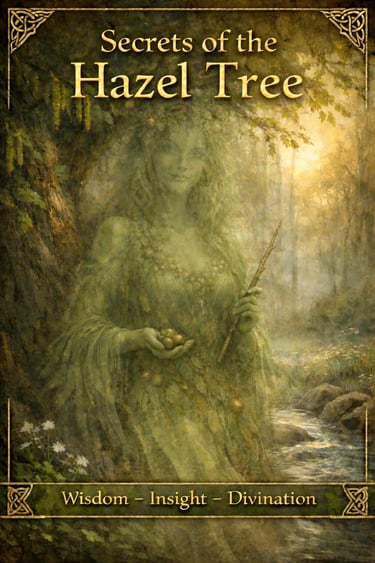

Essence of the Hazel Tree
Bruce Clifton
When to Call on Hazel
When clarity is needed without haste
When truth must be sensed rather than argued
When intuition must be trusted over opinion
When dreams require protection while they take form
Signs of Hazel Presence
A quiet certainty that arrives without effort
An increased sensitivity to unseen currents and pathways
Dreams becoming more vivid, ordered, or instructive
The sense that knowledge is being remembered rather than learned
Hazel in the Inner Landscape
Hazel stands beside water but does not enter it. Rooted firmly on the bank, it leans outward, its branches often overhanging streams and wells. In this posture, Hazel becomes a bridge between what is known and what is hidden — between the conscious mind and the deeper currents beneath it.
Its fruits fall into flowing water, allowing wisdom to be carried forward. Hazel does not hoard knowledge. It releases it, trusting time, movement, and continuity to do their work.
1. The Tree in the Sacred Order
Hazel occupies the threshold between insight and action. It is neither submerged nor withdrawn. It listens before it speaks.
In the sacred order, Hazel governs discernment — the ability to recognise truth without force, and to know the right moment for knowledge to emerge.
2. The Tree in the Living Landscape
Hazel is found close to streams, wells, and rivers, its branches dipping low, its shadow cast over moving water. This proximity marks it as a watcher of currents — surface and subterranean alike.
Its twigs respond to what lies unseen. Forked hazel rods have long been used to locate underground water, new wells, and hidden sources, dipping or crossing where truth lies beneath the ground.
3. Sacred Geography & Ancestral Alignment
When water was found through Hazel, a hazelnut was often planted nearby in thanks — wisdom returned to the land that revealed itself.
Hazel’s presence marks places of passage: wells, riverbanks, hidden crossings. It teaches respect for what is revealed, and responsibility for what is taken.
4. Esoteric & Etheric Attributes
Hazel governs divination, foresight, intuition, and both learned and inherited intelligence. Its wisdom extends into law, judgement, and moral discernment.
In courts, forked hazel twigs were used to weigh guilt and truth. In spiritual practice, they traced ley lines, energy centres, and unseen pathways through land and life alike.
5. The Tree as Conscious Ally
Hazel protects intention. Like the shell of the nut, it shields what is forming until the time is right.
It supports dreams becoming realities — not through force, but through containment. Hazel teaches how to hold vision steady, protected from outside influence, until it is ready to emerge.
6. Mythic & Legendary Associations
The rivers of Avalon, the landscapes of Glastonbury and Wells, and the ever-elusive Camelot are threaded with Hazel’s presence.
A wand cut from Hazel brings focus to magic and intent. To point a Hazel wand is to give direction to thought itself. Tradition holds that Merlin’s wand was made from Hazel — not as a symbol of dominance, but of clarity, alignment, and wisdom made active.
7. Ritual, Practice & Traditional Uses
Hazel twigs are still used today for water divination and dowsing. Held lightly, they respond to hidden currents beneath the feet.
To name a loved one, inscribe it into a hazelnut, and place it into ashes was said to draw reunion — intention released into transformation.
8. Thresholds, Dreams & the Future
Hazel moves easily between worlds: waking and dreaming, surface and depth, present and future.
Its wisdom guards the dreamspace, ensuring that what forms there is not scattered or distorted. Hazel teaches that vision must be protected as carefully as it is pursued.
9. Closing Invocation
Hazel is the keeper of secrets that are meant to be known — but only when the listener is ready.
To sit with Hazel is to learn discernment without judgement, intuition without arrogance, and wisdom without display. It reminds us that true knowledge flows like water: guided, contained, and carried forward into becoming.
Healing - Lore of the Hazel Tree
(Healing)
Bruce Clifton
Healing and the Hazel Tree
Within the Ogham tradition, the Hazel tree is revered as a source of wisdom, discernment, and right knowing. Where Birch clears and renews, Hazel refines and directs. Its healing quality lies not in removal, but in alignment — restoring clarity where confusion, imbalance, or uncertainty have taken hold.
Druidic healing recognised that illness and imbalance were often rooted in misalignment between mind, body, and environment. Hazel was valued for its ability to bring order to scattered energies, supporting sound judgement, intuitive awareness, and the proper flow of inner intelligence. In this way, Hazel was associated with healing that required insight as much as remedy — particularly where decisions, direction, or future outcomes were involved.
Healing, as understood by the Druids, was never singular. Hazel formed part of a wider, integrated approach to natural medicine — one that modern society might separate into herbalism, divination, environmental harmony, and psychology. To the Druids, these were not distinct practices, but expressions of a unified understanding of nature, consciousness, and health. Hazel’s role within this system was to guide the healer toward the correct application of remedies, timing, and intent. (Alchemy)
Historically, Hazel has been associated with the nervous system, cognitive clarity, and circulatory balance. Its nuts were valued as nourishing and strengthening, while its twigs were used diagnostically — locating water, tracing energetic pathways, and revealing unseen influences that could affect health and wellbeing. In this sense, Hazel was not only a healing agent, but a tool for identifying the underlying causes of imbalance.
Scope & Notice
The information contained herein is for educational and entertainment purposes only. All efforts have been made to present accurate, up-to-date, reliable and complete information; however, no warranties of any kind are stated or implied. Readers should acknowledge that the author is not engaged in the rendering of medical or professional advice. The content herein should not be perceived as a substitute for professional or personal guidance. If in doubt, consult a qualified professional before attempting any techniques outlined.
The appropriate dosage or application of any natural remedy is dependent upon various factors, including age, health status, and individual circumstances. Natural products are not inherently safe, and dosage may be critical. It is best practice to begin with lower amounts and adjust as necessary. Consideration should also be given to timing, as the effectiveness of remedies may vary according to time of day and individual sensitivity.
About the Healing List
This list of ailments is not complete in its entirety; it has been limited to the most popular, with the remedies coming firstly from the tree and then vegetation dependent on the tree. It is worthy of note that there is more than one way to make a cup of tea, and many of the ingredients can be purchased online.
We have alphabetised this list of healing qualities of the Hazel Tree solely for ease of reference, they include but are not limited to:
1. Burns
2. Colds
3. Coughs
4. Diarrhoea
5. Fever
6. Haemorrhoids
7. Headaches
8. Indigestion
9. Liver
10. Mental Health
11. Obesity
12. Throat Infections
13. Varicose Veins
Burns / Hazel Tree
Ingredients:
Hazel Bark Ash (Corylus avellana)
Key Properties:
Astringent qualities – Mineral ash – Soothing action – Drying support – Skin-settling properties
Traditional Actions:
Soothes minor burns, eases surface heat, calms irritation, supports skin repair, assists recovery of damaged tissue
Preparation:
Bark from the base of the Hazel tree is traditionally dried, reduced to ash, and then blended with a little clean water to form a simple poultice, or diluted further for use as a gentle wash. It is applied externally in small amounts to the affected area, with care taken that the preparation is clean and the burn is minor in nature.
Traditional Use:
Where the skin has been affected by minor burns, scalds, or surface heat, Hazel has traditionally been used as a quiet restorative to soothe irritation and support recovery. The ash of the bark was valued in household practice as a simple external remedy, helping to settle the damaged area and encourage the skin toward repair.
Its action is not regarded as harsh or forceful, but steady and calming, easing discomfort while helping the surrounding tissue regain balance. In this way, Hazel was used not only to cool the distress of the burn, but to assist the body in restoring order where heat and injury had disturbed the skin.
Within Druidic understanding, a burn reflects sudden excess, where heat has overwhelmed the natural balance of the body. Hazel responds through right measure, drawing the injury back toward calm, containment, and repair. It restores not by force, but by helping the skin settle into the conditions where healing may begin naturally once more.
(See: Holistic Healing Remedies / Burns)
Colds / Hazel Tree
Ingredients:
Hazelnut (Corylus avellana)
Key Properties:
Nutrient-rich oils – Vitamin E – Healthy fats – Trace minerals – Gentle restorative compounds
Traditional Actions:
Supports recovery, restores vitality, nourishes the body, softens dryness, aids return to balance after illness
Preparation:
Hazelnuts are taken fresh, dried, or lightly roasted, then eaten whole or ground into a powder and added to warm drinks or simple foods. They may also be blended into milk or plant-based preparations to create a nourishing drink, taken regularly in moderate amounts as strength returns.
Traditional Use:
Where the body has been weakened by colds, chills, or seasonal illness, the Hazelnut has long been regarded as a gentle restorative, supporting recovery rather than forcing change. It nourishes the system, helping to rebuild strength and warmth once the intensity of the illness has passed.
Its action is subtle yet steady, easing the dryness and depletion often left behind after cold conditions, while supporting the natural return of energy, breath, and resilience. Hazel does not act to suppress the cold itself, but to strengthen the one who carries it, encouraging a gradual and stable recovery.
Within Druidic understanding, a cold reflects a lowering or dispersal of Bnwyfre, where warmth and vitality have been diminished. Hazel restores through nourishment and balance, helping the body gather itself again so that health may re-establish naturally over time.
(See: Holistic Healing Remedies / Colds)
Coughs / Hazel Tree
Ingredients:
Hazelnut – Leaves – Bark (Corylus avellana)
Key Properties:
Soothing compounds – Anti-inflammatory properties – Nutrient-rich oils – Gentle respiratory support
Traditional Actions:
Eases cough irritation, supports respiratory recovery, softens dryness, assists clear breathing, restores balance after illness
Preparation:
Hazelnuts may be ground and added to warm drinks with honey and lemon to create a soothing preparation. Leaves or small amounts of bark may be gently infused in hot water. Steam inhalation can also be used, allowing the warmth and moisture to ease the airways.
Traditional Use:
Where the breath has become unsettled through coughs or lingering respiratory irritation, Hazel has traditionally been used as a gentle restorative, supporting the body as it returns to ease. Its action is not forceful, but softening and steady, helping to calm irritation within the throat and chest while encouraging natural recovery.
Taken as a warm preparation, Hazel helps ease dryness and restriction, allowing the breath to move more freely. It supports the body after illness, particularly where coughing persists beyond the initial cause, restoring comfort without strain.
Within Druidic understanding, a cough reflects disruption within the flow of Bnwyfre through the breath. Hazel responds through balance and containment, settling the disturbance and allowing the natural rhythm of respiration to re-establish itself.
(See: Holistic Healing Remedies / Coughs)
Diarrhoea / Hazel Tree
Ingredients:
Hazel Catkins (Corylus avellana)
Key Properties:
Astringent compounds – Antioxidants – Mild antibacterial qualities – Gut-settling properties
Traditional Actions:
Helps steady the gut, reduces looseness, calms irritation, supports digestive balance, restores stability
Preparation:
Hazel catkins are carefully dried and stored, then rehydrated or used in very small quantities, lightly sprinkled over food or taken with warm preparations. Use is moderate and measured, reflecting their concentrated nature.
Traditional Use:
Where the digestive system has become unsettled through diarrhoea, Hazel catkins have traditionally been used to help steady and restore balance within the gut. Their naturally astringent quality was valued for helping to reduce excess movement and calm irritation within the digestive tract.
The action of Hazel in this form is gentle yet containing, helping the body regain control without force. Rather than suppressing symptoms abruptly, it supports the natural return to stability, easing discomfort and encouraging proper function to re-establish.
Within Druidic understanding, such imbalance reflects a loss of containment within the flow of Bnwyfre, where movement has become excessive or ungrounded. Hazel responds through restraint and right measure, drawing the system back toward balance so that digestion may settle naturally once more.
(See: Holistic Healing Remedies / Diarrhoea)
Fevers / Hazel Tree
Ingredients:
Hazel Bark – Twigs (Corylus avellana)
Key Properties:
Antipyretic properties – Anti-inflammatory compounds – Circulatory support – Cooling action
Traditional Actions:
Helps reduce fever, supports temperature regulation, calms internal heat, encourages recovery, restores balance
Preparation:
Small shavings of hazel bark and twigs are gently boiled in water to create a simple tea. The liquid is then strained and taken warm in moderate amounts, traditionally used during periods of elevated temperature.
Traditional Use:
Where the body is affected by fevers and rising internal heat, Hazel has traditionally been used as a cooling and balancing remedy, helping to regulate temperature and support recovery. The bark and twigs were valued for their antipyretic qualities, assisting the body in easing excess heat without force.
Its action is steady and regulating, working with the body rather than against it, encouraging the natural reduction of fever while supporting the system as it restores equilibrium. Hazel does not suppress the process, but guides it toward resolution.
Within Druidic understanding, fever reflects an intensification of Bnwyfre, where heat has risen beyond balance. Hazel responds through moderation and right measure, drawing the body back from excess and allowing natural harmony to return.
(See: Holistic Healing Remedies / Fevers)
Haemorrhoids / Hazel Tree
Ingredients:
Hazel Leaves – Bark (Corylus avellana)
Key Properties:
Astringent qualities – Anti-inflammatory compounds – Antibacterial properties – Soothing action
Traditional Actions:
Reduces inflammation, soothes irritation, supports tissue tightening, eases discomfort, promotes local recovery
Preparation:
Hazel leaves are traditionally infused or distilled, then incorporated into a simple cream or wash for external application. In some practices, a mild decoction of bark may also be used. Applied gently and in small amounts to the affected area.
Traditional Use:
Where discomfort arises through haemorrhoids, Hazel has traditionally been used as a soothing and containing remedy, helping to reduce inflammation and ease irritation in the affected area. Its astringent nature supports the tightening of tissues, encouraging stability and relief.
The action is calming and restorative, assisting the body in regaining balance without harsh intervention. Used externally, it supports the delicate tissues while helping to reduce swelling and discomfort.
Within Druidic understanding, such conditions reflect pressure and stagnation within the lower flow of Bnwyfre. Hazel responds through containment and right measure, easing excess and restoring balance so that the body may return to comfort naturally.
(See: Holistic Healing Remedies / Haemorrhoids)
Headaches / Hazel Tree
Ingredients:
Hazelnut (Corylus avellana)
Key Properties:
Magnesium – Omega-3 fatty acids – Vitamin E – Healthy fats – Nervous system support
Traditional Actions:
Eases tension-related headaches, supports nervous system balance, reduces mental strain, encourages clarity, restores steadiness
Preparation:
Hazelnuts are taken whole, lightly roasted, or ground, and incorporated into simple foods or warm drinks. They may also be kept nearby in a bowl, allowing their presence to contribute to a calmer environment.
Traditional Use:
Where headaches arise through tension, mental strain, or overwhelm, Hazel has traditionally been regarded as a steadying influence, supporting both the body and the mind. The nutrient-rich hazelnut nourishes the nervous system, helping to ease the underlying conditions that contribute to discomfort.
Its action is gentle and grounding, working to reduce internal pressure rather than forcing relief. By supporting clarity and calming mental agitation, Hazel helps the body return to a more balanced state where headaches may naturally subside.
Within Druidic understanding, headaches reflect congestion or imbalance within the flow of Bnwyfre, particularly in the realm of thought and perception. Hazel responds through clarity and right measure, easing the pressure and allowing natural rhythm to return.
(See: Holistic Healing Remedies / Headaches)
Indigestion / Hazel Tree
Ingredients:
Hazelnut (Corylus avellana)
Key Properties:
Dietary fibre – Antioxidants – Healthy fats – Digestive support – Nutrient-rich compounds
Traditional Actions:
Supports digestion, encourages natural bowel movement, eases discomfort, aids metabolic balance, restores digestive rhythm
Preparation:
Hazelnuts are taken whole, lightly roasted, or ground, and incorporated into simple foods such as breads, porridges, or warm drinks. Regular, moderate intake is favoured to support steady digestive function.
Traditional Use:
Where the digestive system becomes unsettled through indigestion, Hazel has traditionally been used as a gentle digestive support, helping the body return to its natural rhythm. The fibre and nutrient-rich oils within hazelnuts assist the movement and balance of the digestive process, easing discomfort without force.
Its action is steady and regulating, encouraging proper function rather than overriding it. By supporting digestion and metabolic balance, Hazel helps reduce the heaviness and stagnation often associated with indigestion.
Within Druidic understanding, indigestion reflects a disruption in the transformation of Bnwyfre, where nourishment is not being properly received or processed. Hazel responds through balance and right measure, helping the body restore its natural digestive flow.
(See: Holistic Healing Remedies / Indigestion)
Liver / Hazel Tree
Ingredients:
Hazel Leaves – Hazelnut (Corylus avellana)
Key Properties:
Anti-inflammatory compounds – Vitamin E – Healthy fats – Antioxidants – Liver-supporting nutrients
Traditional Actions:
Supports liver function, aids fat metabolism, reduces internal inflammation, promotes detox balance, restores vitality
Preparation:
Hazel leaves may be gently infused to create a mild tea, while hazelnuts are taken whole, lightly roasted, or ground into foods and warm preparations. Regular, moderate use is favoured to support ongoing balance.
Traditional Use:
Where the body shows signs of imbalance within the liver, Hazel has traditionally been used as a supportive and restoring ally, helping to ease internal strain and encourage proper function. The combined action of leaves and nuts provides nourishment and gentle support to the body’s natural processes.
Its influence is steady and balancing, assisting the regulation of fats and supporting the reduction of internal congestion. Rather than forcing change, Hazel works to restore the conditions in which the liver may function more freely and efficiently.
Within Druidic understanding, liver imbalance reflects a burden within the flow of Bnwyfre, where processing and transformation have become hindered. Hazel responds through clarity and right measure, helping to lighten this burden and return the system to a more natural state of balance.
(See: Holistic Healing Remedies / Liver)
Mental Health - Hazel Tree
Ingredients:
Hazelnut (Corylus avellana)
Key Properties:
Polyphenols – Antioxidants – Healthy fatty acids – Vitamin E – Trace minerals
Traditional Actions:
Nervous system nourishment, cognitive support, antioxidant protection, strengthening mental resilience
Preparation:
Hazelnuts are gathered when fully ripe, typically in early autumn once the husks begin to open naturally. The nuts may be dried and stored in a cool, dry place for later use.
They are traditionally eaten whole, lightly roasted, or ground and incorporated into simple foods such as breads, cakes, or nourishing pastes. Hazelnuts may also be crushed and added to broths or porridges, allowing their oils and nutrients to be absorbed gradually.
Ground hazelnuts can also be blended with warm liquids such as milk or plant-based preparations to create a nourishing drink traditionally associated with strengthening the body and mind.
Traditional Use:
Within traditional European plant practice, hazel has long been associated with wisdom, clarity of thought, and the nourishment of the mind. Hazelnuts were valued not only as a sustaining food but also as a source of nutrients believed to support the health of the nervous system.
Rich in antioxidants, polyphenolic compounds, vitamins, and beneficial oils, hazelnuts have traditionally been regarded as supportive where mental fatigue, nervous strain, or cognitive decline are present. Modern observations also suggest these compounds may help protect the brain from degenerative processes associated with conditions such as Alzheimer’s disease and Parkinson’s disease.
Through steady nourishment rather than sudden stimulation, hazel has therefore been associated with maintaining clarity of thought, strengthening mental resilience, and supporting long-term brain health.
(See: Holistic Healing Remedies / Mental Health)
Obesity / Hazel Tree
Ingredients:
Hazelnut (Corylus avellana)
Key Properties:
Healthy fats – Dietary fibre – Antioxidants – Satiety-supporting nutrients – Metabolic support
Traditional Actions:
Supports weight balance, promotes satiety, regulates appetite, aids metabolism, reduces excess accumulation
Preparation:
Hazelnuts are taken whole, lightly roasted, or ground, and incorporated into meals or simple snacks. Regular, moderate consumption is favoured, supporting nourishment without excess.
Traditional Use:
Where the body carries excess weight through obesity or imbalance, Hazel has traditionally been regarded as a steady and nourishing ally, supporting the body in finding its natural balance. The healthy fats and fibre within hazelnuts help promote a sense of fullness, reducing unnecessary intake while sustaining energy.
Its action is grounding and regulating, working through nourishment rather than restriction. By supporting appetite control and metabolic function, Hazel assists in easing excess accumulation over time, encouraging a more balanced state.
Within Druidic understanding, obesity reflects an imbalance in the storage and movement of Bnwyfre, where energy has become held rather than circulated. Hazel responds through balance and right measure, helping restore flow so that the body may return to its natural equilibrium.
(See: Holistic Healing Remedies / Obesity)
Throat (Infections) / Hazel Tree
Ingredients:
Hazelnut – Shell (Corylus avellana)
Key Properties:
Antimicrobial properties – Anti-inflammatory compounds – Soothing action – Oral support
Traditional Actions:
Eases throat irritation, supports oral health, reduces infection presence, calms inflammation, restores comfort
Preparation:
Hazelnut, including the shell, is traditionally prepared as a mild infusion or mouthwash, allowed to cool slightly before use. It may be used as a gentle rinse or gargle, applied regularly in small amounts.
Traditional Use:
Where the throat has become affected by infection, soreness, or irritation, Hazel has traditionally been used as a soothing and protective remedy, helping to calm inflammation and support recovery. Its antimicrobial qualities were valued for maintaining oral balance and reducing the presence of infection.
Its action is gentle and steady, easing discomfort while supporting the natural healing processes of the throat. Used as a rinse or gargle, it helps restore comfort without harsh intervention.
Within Druidic understanding, throat infection reflects a disturbance within the expression of Bnwyfre, where flow through breath and voice has become restricted. Hazel responds through containment and right measure, calming the disturbance and allowing clear expression and comfort to return.
(See: Holistic Healing Remedies / Throat Infections)
Varicose Veins / Hazel Tree
Ingredients:
Hazelnut (Corylus avellana)
Key Properties:
Antioxidants – Omega-3 fatty acids – Healthy fats – Circulatory support – Anti-inflammatory compounds
Traditional Actions:
Supports circulation, strengthens blood flow, reduces inflammation, protects vessels, promotes vascular balance
Preparation:
Hazelnuts are taken whole, lightly roasted, or ground, and incorporated into daily meals or simple foods. Regular, moderate intake is favoured to support ongoing circulatory health.
Traditional Use:
Where discomfort arises through varicose veins, Hazel has traditionally been used as a supportive and strengthening ally, helping to improve circulation and maintain vascular health. The antioxidants and healthy fats within hazelnuts support the integrity of blood vessels while encouraging smoother flow.
Its action is steady and restorative, assisting in reducing inflammation and easing the heaviness often associated with poor circulation. Rather than acting directly upon the veins, Hazel supports the wider system, encouraging balance and improved function over time.
Within Druidic understanding, varicose veins reflect a slowing or stagnation within the movement of Bnwyfre, where flow has become restricted. Hazel responds through balance and right measure, helping to restore movement and ease within the circulatory system.
The Ninth Tree of the Ogham Calendar
Hazel is the ninth tree of the Ogham calendar, known as Coll, and she stands at the height of summer when growth has matured into knowing. Her moon runs from 14th July to 11th August, a time known as the Lightning Moon or Wort Moon, when heat quickens thought and the land hums with stored energy. Hazel does not rush to flower nor hurry to fade; she gathers quietly, drawing strength inward, concentrating wisdom into nut and branch. She grows at the forest’s edge and beside streams, where land meets water and thought meets feeling, reminding us that insight is born where currents cross.
Hazel is not the beginning of the forest, nor its ending. She is the moment of understanding — when experience settles into knowledge and knowledge ripens into wisdom.
Keeper of Wisdom and Inspiration
In Celtic tradition, Hazel is the Tree of Knowledge, long associated with wisdom, memory, poetry, and inspired speech. Around the sacred wells, hazel trees were said to overhang the waters, dropping their nuts into the depths below. From these waters swam the salmon of wisdom, their knowledge earned through patience and nourishment rather than force. To eat of the hazel-fed salmon was to receive insight not taught, but remembered.
Hazel teaches that wisdom is not seized. It is gathered, slowly and attentively, through listening, observing, and allowing understanding to rise of its own accord.
The Lightning Moon and the Stirring of Thought
Under the Lightning Moon, Hazel’s energy quickens the mind. This is a time of flashes — sudden insight, sharp realisation, words arriving fully formed. Yet Hazel tempers brilliance with balance; she does not scatter thought wildly but shapes it into something useful and lasting. Her branches are flexible, not brittle, bending under the weight of learning rather than snapping beneath it.
Those who sit with Hazel during this moon may find clarity where confusion once lay, and a calm confidence where doubt had taken root.
Hazel Rods, Divining, and the Hidden Currents
Hazel wood has long been favoured for divining rods, not because it commands hidden forces, but because it is sensitive to them. In the hands of those who listen, Hazel responds to unseen currents — water beneath the soil, pathways beneath appearances, truths beneath words. As a staff or wand, Hazel carries authority without dominance, guiding rather than compelling.
This is a tree that reveals rather than announces.
Household Wisdom and Quiet Authority
Hazel’s knowledge belongs as much to the hearth as to the grove. Her uses were passed through families, learned by watching hands at work rather than reading instruction. Bark, leaf, and nut each carry a different gift, and knowing which to use — and when — was a mark of practical wisdom. Hazel does not demand reverence; she earns trust through reliability.
In this way, she became the tree of the wise woman, the poet, the storyteller, and the quiet counsellor — those whose authority rests not in position, but in understanding.
Between Water and Land
Hazel thrives where roots can reach moisture and branches can reach light. She stands between worlds — emotion and reason, intuition and intellect, memory and speech. To sit beneath Hazel is to be reminded that knowledge is not stored only in the mind, but in the body, the breath, and the living land itself.
She invites us to pause, to listen deeply, and to allow meaning to emerge rather than be forced.
Walking with Hazel
To walk with Hazel during her moon is to walk with discernment. She teaches when to speak and when to remain silent, when to act and when to wait. She reminds us that true wisdom carries humility, and that insight is sharpened not by certainty, but by curiosity.
Those who honour Hazel learn not merely to know — but to understand.
Bruce Clifton
Celtic Tree Lore of the Hazel Tree
Folklore of the Hazel Tree
Bruce Clifton
Folklore – Hazel Tree
The hazel tree has long been regarded as a keeper of wisdom and hidden knowing, approached not as a resource to be taken from, but as a presence to be consulted. In folk tradition, hazel teaches restraint and attentiveness; nuts found upon the ground are considered gifts freely given, while branches and bark are never taken without need or permission. To gather fallen twigs or naturally shed wood is to accept what the tree has already released, honouring the balance between use and respect.
These offerings of hazel were believed to carry clarity rather than power — quiet aids for discernment, insight, and right judgement. Carried by travellers or kept within the home, hazel wood was said to steady thought and guard against confusion, helping one remain aligned when choices became unclear.
Wisdom and Divination
Hazel has long been favoured in folk divination, its branches shaped into rods used to sense hidden water, buried paths, or unseen currents. Folklore holds that hazel does not reveal itself to force, but responds to stillness and attention. Those who worked with hazel were cautioned to approach without haste, for the tree was believed to withdraw from those who sought answers too quickly or without humility.
Sitting beneath hazel was said to sharpen memory and invite insight, particularly when the mind felt scattered or clouded. In this way, hazel became a companion of poets, storytellers, and wise women — those whose work required listening as much as speaking.
Sacred Harvest and Household Tradition
In household lore, hazel was gathered according to season and need, never stripped or wasted. Nuts were collected as nourishment for winter and as symbols of concentrated wisdom, while leaves and bark were used sparingly for healing and practical care. Timing mattered: hazel was often approached during calm weather or settled moon phases, when thought and intention were believed to be most aligned.
Unlike trees of overt protection or warding, hazel’s role was subtler. It did not shield by force, but by understanding — guiding those who worked with it toward clarity, balance, and right measure. In this way, hazel folklore reminds us that wisdom itself is a form of protection, and that the deepest guidance often arrives quietly, through patience, respect, and trust in what the land is willing to share.
Hazel and the Spoken Word
In Celtic oral tradition, hazel is closely bound to speech — not idle talk, but measured words shaped by understanding. It is said that hazel listens before it answers, and those who work with its wood or sit within its shade learn to do the same. Storytellers and poets were believed to favour hazel staffs, not as symbols of authority, but as reminders that true speech arises from attentiveness and memory. Words spoken in haste were thought to lose their way, while words spoken with hazel’s patience found their mark.
Old sayings caution that hazel should never be used to deceive, for its gift is clarity, not cleverness. To speak falsely while holding hazel was believed to invite confusion rather than success. In this way, the tree became a quiet moral guide, shaping not only what was known, but how knowledge was carried into the world.
Paths, Thresholds, and Right Measure
Hazel often grows at boundaries — woodland edges, stream banks, field margins — and folklore reflects this liminal nature. It is a tree of thresholds, guiding those who stand between decisions, seasons, or states of mind. To walk with a hazel switch was said to help one choose the right path when many appeared open, not by revealing the future, but by sharpening discernment in the present moment.
Because of this, hazel was respected as a teacher of right measure. It cautioned against excess, impatience, and force, reminding those who worked with it that balance is not found in extremes, but in knowing when enough has been gathered, spoken, or done. In household lore, this quality made hazel a tree of quiet order, helping to keep harmony within the home and clarity within the mind.
Animal Spirits of the Hazel Tree
Animal Spirits and Recognition
Animal spirits are not symbols to be claimed, but intelligences encountered through attention, patience, and relationship. In Celtic understanding, they arise where land, water, and memory intersect, responding to awareness rather than demand. Their appearance is not instruction but resonance — a reflection of inner alignment taking form in the living world. When an animal spirit associated with Hazel appears repeatedly, it signals readiness to receive insight rather than a message to be deciphered.
Hazel as the Tree of Insight
Hazel grows where understanding is gathered rather than imposed — at woodland edges, beside streams, and along paths of quiet movement. Its animal companions are those attuned to observation, discernment, and stored knowledge. These beings watch, remember, and act with precision, revealing themselves when timing and perception are aligned. They do not rush forward; they wait until clarity has formed.
Wisdom of Discernment and Measure
Together, Hazel’s animal spirits speak of wisdom earned through listening and restraint. They embody alertness without tension, intelligence without noise, and action guided by understanding rather than impulse. These spirits often accompany those navigating decisions, study, healing after illness, or periods where thought must be shaped into right action. Their presence reminds us that true knowledge ripens slowly and is strongest when carried with humility.
Aether and Shared Essence
The aether, or quintessence, of Hazel carries the quality of concentrated awareness — the distillation of experience into insight. This subtle field attracts animal spirits aligned with memory, perception, and quiet intelligence, forming a living relationship between tree, creature, and consciousness. In this shared space, understanding does not arrive suddenly, but settles — clear, grounded, and enduring.
Bruce Clifton
We have alphabetised this list of animal spirit that harmonise with the alder tree solely for ease of reference, no sense of hierarchy or entitlement is intended or implied:
1) Mouse
2) Salmon
3) Squirrel
Mouse
Mouse is the influence you do not know is there, it is only when you look for it that it becomes obvious. The mighty Elephant is scared of the mouse but only when Mouse makes himself known. Encourage mouse out of hiding by being kind, a few crumbs and mouse will be on your side.
Autumn and you will find mouse hoarding food, collecting food and storing it for the long winter nights. Winter and Mouse is in semi-hibernation conserving energy and not becoming prey for anything bigger than itself. Spring and Mouse is the gatherer and romanticist, providing food and creating his harem, gathering food and making good use of anything it finds for its family. The long days of summer and it is heaven on earth for this tiny creature enjoying all that life has to offer care free and living the life of abundance surrounded by family.
Mouse is quietly bound to Hazel through rhythm, nourishment, and timing. Hazel provides the nut that sustains Dormouse through the long preparation for winter, its energy stored slowly and deliberately, mirroring the dormouse’s own careful gathering and deep seasonal awareness. In this relationship, Hazel teaches discernment and right measure, while Mouse embodies patience, memory, and the wisdom of withdrawal. Neither rushes; both understand that survival and insight depend on knowing when to act and when to sleep.
(See: Mouse)
Salmon / Hazel Tree
Keeper of the Living Waters
Where the Hazel tree grows beside quiet pools and slow rivers, the salmon has long been recognised as a bearer of wisdom. In Celtic tradition the sacred hazelnuts were said to fall into the water, where the salmon fed upon them and gathered the knowledge of the world. The tree and the river together formed a place where insight was believed to awaken.
Wisdom of the Returning Journey
The salmon’s long journey from sea to river reflects the patient search for understanding. Guided by instinct and memory, it travels back to its source, just as wisdom returns to those who listen carefully to the rhythms of nature. Beneath the branches of Hazel, this journey becomes a living symbol of knowledge gained through experience.
The Salmon of Knowledge
In the old stories the salmon who fed upon the hazelnuts of wisdom became the Salmon of Knowledge, keeper of ancient insight and memory. Where Hazel leans over the waters, the presence of salmon reminds us that true wisdom is not forced but gathered slowly through observation, patience, and the quiet teachings of the natural world.
Squirrel
Squirrel is bound to the hazelnut through instinct, preparation, and the wisdom of foresight. Hazel offers its nuts as concentrated nourishment, and squirrel answers by gathering, caching, and remembering — storing what is needed long before scarcity arrives. In this relationship, the hazelnut represents potential held in reserve, while squirrel embodies alertness, quick intelligence, and the necessity of preparation. Nothing is taken without purpose; nothing is gathered without thought of the future.
In Nordic legend, the squirrel appears as Ratatoskr, the swift messenger who runs the length of the World Tree, carrying words and memory between realms. Paired with the hazelnut, this echoes the same northern understanding: wisdom is gathered in small, concentrated forms and moved quickly where it is needed, linking root and crown, earth and thought, through alertness, preparation, and motion.
Bruce Clifton
The Hazel as Keeper of Threshold Intelligence
The hazel is not a magnet in the way of alder, nor a ruler like oak; it is a keeper of thresholds. It grows where boundaries meet, woodland edge, river margin, old paths, and in these places it gathers intelligences rather than drawing them in by force. Hazel does not summon elementals; it hosts awareness, creating conditions in which subtle presences can be recognised. Its energy is one of concentration and discernment, where knowledge settles and becomes accessible.
Hazel teaches that not all power is expansive. Some power is held, refined, and released only when timing is right.
Recognition, Attention, and the Human Witness
As with all subtle phenomena, Hazel’s influence depends upon the human witness. Hazel does not reveal itself through spectacle, but through attention. Synchronicity arises here not through convergence, but through alignment, when mind, place, and moment quietly agree. Those who linger with Hazel may notice patterns repeating: animals returning, thoughts clarifying, paths resolving themselves without effort.
Hazel does not orchestrate events; it sharpens perception so that what is already present can be seen.
Bnwyfre and the Quiet Flow of Knowing
Within the Celtic understanding, Hazel carries Bnwyfre not as a surge, but as a steady current of knowing. It is the life force refined into insight, breath slowed into thought, energy gathered into memory. This quality makes Hazel a natural companion to poets, seers, wise women, and those who work with spoken tradition, where knowledge must be held intact before it is released into the world.
Bnwyfre moves through Hazel like water through a still pool: clear, contained, and reflective.
Assimilation, Memory, and Living Tradition
Celtic culture did not impose its understanding of Hazel upon the land; it recognised what was already there. Local spirits, totems, and intelligences associated with Hazel were acknowledged and woven into wider tradition, allowing continuity without erasure. This adaptive quality ensured that Hazel remained a living presence rather than a fixed symbol, shaped by place, people, and use.
Thus, Hazel stands not as a single entity, but as a meeting place of intelligences, where land memory, animal presence, and human awareness quietly converge.
Local Totems and the Hazel Current
For this reason, the totems and entities associated with Hazel vary by region, yet share common qualities: attentiveness, memory, preparation, and discernment. Creatures such as dormouse, squirrel, and salmon move within Hazel’s current, each expressing a different relationship to stored wisdom, stillness, activity, and journey.
Together, they remind us that knowledge is not owned, but carried — and that Hazel remains one of the forest’s most patient teachers.
We have alphabetised this list of totems and entities that harmonise with the hazel tree solely for ease of reference, no sense of hierarchy or entitlement is intended or implied:
1) Crone
2) Faery
3) Hildegard
Crone
Crone in the Celtic cycle, Elder closes the gate and Hazel teaches how to walk on. One completes the year; the other interprets it. The power of endings gives way to the wisdom of beginnings, and the land remembers itself through the quiet continuity between them. It is the crone that understands the ways of seasonal shift, the turning of the wheel, when to give freely and when to hold in reserve.
(See: Totems and Entities)
Faery
While Hazel is not a faery tree in the same manner as Hawthorn, it is frequently found at liminal sites, wells, streams, woodland edges, where subtle presences gather. In such places, faery intelligences are encountered not as spectacle, but as quiet tests of awareness. Hazel does not open doors; it sharpens perception, allowing what already exists to be recognised.
The cup that holds the hazelnut on the tree is often found empty near the hazel, serving as evidence of the merriment, faery gatherings, dancing, and spellcasting that occur.
Hildegard of Bingen
Hildegard can be called forward simply by request, an unmistakeable figure and yet seldom acknowledged.
She is drawn to the hazel tree because hazel carries the order of creation she so faithfully described — wisdom shaped by divine breath and held in living balance. As hazel gathers knowledge quietly and releases it only when it has ripened, so Hildegard taught that understanding flows from God through viriditas, the greening life-force that sustains all being. Beneath hazel’s boughs, thought is tempered, vision is softened, and insight is brought into right measure. Her presence is not one of spectacle, but of alignment, a gentle settling of the soul, where breath, mind, and creation return to harmony, and the divine intelligence of the living world is once again felt as love rather than command.
(See: Totems and Entities)
Totems and Entities of the Hazel Tree
Bruce Clifton
Gods and Deities of the Hazel Tree
Hazel and the Quiet Authority of Wisdom
Hazel is not known through conquest, lineage, or monument, but through recognition. She does not rule a territory nor guard a single place; instead, she presides wherever understanding has been patiently gathered and held in balance. In Celtic tradition, Hazel is encountered beside wells, along woodland edges, and in the half-light of reflection, places where knowledge is not proclaimed, but received. Her presence is subtle yet unmistakable, marked by clarity settling where confusion once lingered.
Unlike heroic figures whose power is bound to deeds or dominion, Hazel’s authority lies in discernment. She governs the moment when experience becomes insight, and when insight becomes counsel rather than command.
Wisdom as Guardianship
Where Bran’s guardianship is embodied by ravens standing watch, Hazel’s guardianship takes a quieter form. She protects not land or city, but understanding itself. In her keeping, knowledge is not scattered or misused; it is stored, refined, and released only when it can serve life without harm. This restraint is her strength, and it is why Hazel is associated with poets, wise women, and those entrusted with memory rather than rule.
To encounter Hazel is to be reminded that wisdom, once violated or forced into use too early, loses its power. She stands as a safeguard against haste, ensuring that what is known is carried responsibly.
Celtic Knowing and the Flow of Bnwyfre
Within Celtic thought, Hazel embodies a refined movement of Bnwyfre, life-force drawn inward, clarified, and shaped into understanding. This is not the surge of energy seen in battle or ritual fire, but a steady current that moves through breath, thought, and speech. Druids and poets alike recognised this quality, working with Hazel not to summon power, but to align themselves with right order and right timing.
In this way, Hazel becomes a living expression of Celtic knowing: wisdom transmitted through voice, memory, and presence rather than written law.
Continuity Through Adaptation
As Celtic culture encountered new lands, peoples, and beliefs, Hazel remained relevant precisely because she did not demand fixed form. She could be recognised wherever discernment, counsel, and measured speech were valued. This adaptability allowed Hazel’s current to move quietly through changing societies, absorbed into household practice, poetic tradition, and spiritual reflection without losing its core nature.
Hazel endures not as a singular myth, but as a continuing intelligence within the land.
Local Presence and Living Tradition
For this reason, Hazel appears here not as a universal ruler, but as a local deity of wisdom, encountered where knowledge must be handled with care. Her lineage is not traced through blood or crown, but through memory, insight, and the quiet authority of those who listen before they speak.
She remains present wherever the old understanding survives: that wisdom is not seized, but recognised — and that the greatest protection lies not in force, but in knowing when enough has been learned.
We have alphabetised this list of Gods and Deities that harmonise with the hazel tree solely for ease of reference, no sense of hierarchy or entitlement is intended or implied:
1) Brigid
2) Hermes Trismegistus
Brigid / Hazel Tree
Celtic Goddess of Poetry and Wisdom
Brigid’s connection with the hazel tree arises through its long-standing symbolism of wisdom, poetic inspiration, and sacred knowledge within Celtic tradition. Hazel was regarded as the Tree of Wisdom, most famously in the legend of the sacred hazels surrounding the Well of Segais, where the falling hazelnuts carried knowledge that was taken up by the Salmon of Wisdom. In this landscape of well, water, and living knowledge, the hazel became a natural emblem of inspired thought and poetic insight.
As goddess of poetry and inspiration, Brigid stands closely aligned with these same qualities. Early tradition remembers her as the patron deity of poets and sacred speech, a figure who awakens insight and creative understanding within the human mind. The hazel therefore reflects the same current of inspired knowledge, where wisdom is not forced but discovered through attentive listening and reflection.
Hazel has also been linked with divination and the seeking of hidden things, often through the use of hazel rods for dowsing or spiritual guidance. This association strengthens its connection to Brigid’s inspirational nature, as both the goddess and the tree are understood as guides toward deeper perception and truth. In folklore, hazel is sometimes directly associated with Brigid because it embodies the same current of inspiration and poetic awakening that she represents.
Within the hazel groves of Celtic memory, the presence of Brigid can therefore be understood as the spark of inspiration within wisdom itself. Just as the hazelnut hides knowledge within its shell, Brigid’s influence awakens the insight that lies waiting within the human spirit. In this way the hazel stands as a natural companion to the goddess, a living reminder that true wisdom grows quietly from the land, the well, and the inspired mind.
(See: Brigid / Celtic Gods and Deities)
Hermes Trismegistus
Hermes Trismegistus is known in the Hermetic tradition as the bearer of sacred knowledge — the one who transmits hidden understanding between heaven and earth. He stands at the threshold between worlds, translating divine order into human comprehension. In this, he does not command power; he interprets it.
Hazel performs a similar function within Celtic understanding. It is not a tree of dominion or spectacle, but of discernment, holding knowledge in concentrated form and releasing it only when it has matured. Where Hermes articulates the principle “as above, so below,” Hazel embodies it in living form: root and branch mirroring one another, water and land in quiet conversation, wisdom gathered from depth and shaped for speech.
Hermes carries the caduceus, a staff entwined with serpents, a symbol of balance, duality, and reconciliation of opposites. Hazel carries the rod — not as a weapon, but as a sensing instrument, a guide for hidden currents. Both staffs signify mediation rather than authority. They are tools of alignment.
Bruce Clifton
Secret Harmonies of the Hazel Tree
Hazel as Keeper of Concentrated Wisdom
Hazel, with its quiet authority and inward-gathering strength, functions not as an alchemist of forces, but as a refiner of understanding. Much like the reflective Willow, the steadfast Oak, and the threshold-guarding Elder, Hazel possesses the rare ability to distil experience into insight. Where other trees harmonise movement or summon presence, Hazel gathers what has already been lived and shapes it into something coherent and usable. It does not weave energies together; it clarifies them. In this way, Hazel creates a field in which thought becomes ordered, memory becomes accessible, and knowledge settles into right measure.
This concentrated current does not dominate the surrounding energies, it steadies them. Under Hazel, complexity simplifies without reduction, and distraction dissolves into focus. The harmony here is not one of expansion, but of refinement.
Elemental and Etheric Discernment
Hazel naturally aligns earth and water, root and well, soil and stream, forming a living bridge between grounded experience and flowing awareness. Within its field gather presences attuned to perception rather than spectacle: the salmon of deep memory, the dormouse of stored knowing, the owl of silent watchfulness. Subtle beings of the air and water currents, sylph-like intelligences and undine qualities, are not summoned, but recognised where balance already exists.
Hazel does not command elementals; it provides a stable meeting place where their movements can be perceived clearly. The etheric quality of Hazel is not forceful light, but lucid clarity, a still pool in which reflection becomes possible.
Interconnectedness, Memory, and Right Measure
What sets Hazel apart is its relationship with time. It does not rush the season, nor does it cling to what has passed. Instead, Hazel holds the accumulated memory of growth, storing it within the nut and branch until the moment of release arrives. In folklore and tradition, Hazel is linked to wells of wisdom and to speech shaped by restraint. It stands at the intersection of experience and articulation, asking not “What is powerful?” but “What is true?”
Hazel’s harmony is therefore one of discernment. It teaches that not all energy requires blending; some must be separated, understood, and placed correctly. In this, it mirrors the ancient sage who listens before speaking, aware that timing determines whether knowledge heals or harms.
This list of harmonious attributes is not exhaustive; it reflects only the most commonly recognised qualities associated with Hazel’s current. Harmony here does not arise through dramatic convergence, but through clarity of placement. Synchronicity within Hazel’s field emerges when time, place, and circumstance align with readiness. It is readiness — more than force — that allows true harmony to occur.
We have alphabetised this list of secret harmonies of the hazel tree solely for ease of reference, no sense of hierarchy or entitlement is intended or implied:
1) Clairs
2) Divination
3) Divination - (Decision making)
4 Lucid Dreaming
5) Portal
6) Psychic Ailities
Clairs
The hazel tree may have been cultivated to enhance clairvoyant abilities. The hazel tree enhances all psychic abilities, exerting a tangible influence on the human psyche across physical, mental, and emotional levels.
Hazel governs perception that has been steadied, not stimulated. Within her current, the so-called clair-abilities do not arrive as dramatic visions or overwhelming sensation; they emerge as quiet clarity. Hazel refines awareness until what was once faint becomes recognisable. She does not heighten imagination, she filters it, ensuring that what remains is measured and trustworthy.
Hazel insists on one condition: restraint. She teaches that perception must be tested against time and context. Not every impression is truth; not every feeling is insight. Under Hazel, discernment acts as safeguard. The rod she carries is not for summoning but for sensing — checking alignment before action.
In this way, Hazel transforms clair abilities from gifts of spectacle into tools of responsibility. She reminds us that clarity without humility becomes distortion and that true perception serves life quietly.
Divination
Hazel – Divination refers to the practice or ability to obtain knowledge about the future, often through spiritual or supernatural means, in order to gain insights or information regarding specific questions or circumstances.
Divination, in its truest sense, is not the dramatic unveiling of fate, but the careful reading of pattern, rhythm, and probability. It is the disciplined art of perceiving how present conditions are likely to unfold when guided by their natural trajectory. Under Hazel’s influence, divination is not fortune-telling; it is discernment applied to time.
Hazel reminds us that the future is not fixed, but patterned. By recognising those patterns, in land, season, behaviour, and inner movement, one gains foresight without arrogance. Divination, then, becomes an act of alignment rather than prediction: an attunement to how energy is likely to move when left undisturbed.
(See: Harmony)
Divination - (Decision making)
Decision-making: Pendulums or divining rod/s produce a yes/no answer to questions or subject matter, water, metals, lost items. The hazel twig is used for matters of the heart, to locate lost items, or when divining for water. The rowan twig is better suited for divining for minerals and precious metals.
Divination within Hazel’s current therefore relies less on spectacle and more on steadiness. It asks the practitioner to slow the breath, clear projection from perception, and observe without urgency. Insight gained through Hazel is measured, contextual, and responsible. It does not promise certainty; it offers probability shaped by understanding.
Insight gained under Hazel is measured, contextual, and responsible. It does not claim certainty, nor does it remove personal accountability. Instead, it offers probability shaped by understanding, a clearer view of how choices may influence outcome. Hazel teaches that wise decisions arise from discernment: weighing timing, consequence, and readiness before action is taken.
As a pendulum reveals Yes/No answers, the hazel reveals the truth in the question.
(See: Harmony)
Lucid Dreaming
Lucid dreaming is the state in which one becomes aware of dreaming while still within the dream. It is not the manipulation of fantasy, but the recognition of consciousness moving through another layer of perception. Within Hazel’s current, this awareness is supported through steadiness and clarity rather than force.
Hazel refines the observer. Just as the tree teaches discernment in waking life, it steadies the inner witness during sleep. The dream unfolds uniquely for each individual, yet under Hazel’s influence it may feel less chaotic and more coherent — as though one is watching events with quiet presence rather than being swept away by them. The experience resembles observing a film while knowing you are both audience and participant.
Hazel does not impose control over the dream; it encourages recognition. Awareness becomes the guiding thread. In this way, lucid dreaming becomes less about altering events and more about understanding what the dream is revealing. (See also: Astral Travel – Dream Walking)
(See: Harmony)
Portal
Hazel offers a distinctive gateway, though not in the theatrical sense of a doorway torn open between worlds. Its portal is subtler. It is a threshold of perception, a shift in awareness rather than location. Under Hazel’s influence, the boundaries between seen and unseen, waking and dreaming, earthly and celestial feel less rigid, more permeable.
To step into Hazel’s field is not to leave this world, but to experience it differently. The sphere it opens is one in which terrestrial presences, creatures of root, water, and woodland exist alongside subtler intelligences often described as elemental or etheric. These are not summoned; they are recognised. Hazel refines the senses so that what was once overlooked becomes visible.
The gateway Hazel offers is therefore inward as much as outward. It invites entry into layered awareness, where earth and sky are understood as part of a single living continuum. In this space, perception widens without losing grounding. The realm encountered is not elsewhere — it is the deeper dimension of what already surrounds us.
(See: Harmony)
Psychic Abilities
Within a holistic understanding, Hazel does not “grant” psychic powers, nor does it bestow abilities that were not already present. Instead, Hazel refines the perceiver. It creates a field of steadiness in which subtle perception can emerge more clearly.
When time is spent consciously with Hazel — whether through contemplation, ritual, or quiet presence — the nervous system often settles. Breath slows. Attention sharpens. Internal dialogue softens. In this steadied state, many people report an increased sensitivity to intuition, pattern, and subtle emotional shifts. What might be described as clairvoyance or claircognizance can arise simply because distraction has diminished.
Hazel’s influence, in this sense, is not supernatural — it is harmonising. It encourages observation without projection and receptivity without urgency. Insight becomes quieter but more coherent. Rather than amplifying sensation, Hazel filters noise.
(See: Harmony)
This page was last updated 12th Feb 2026

Copyright © 2004 - 2026 Bruce Clifton
The Spiritual Centre
Seaham,
County Durham, SR7 7
Bruce@thespiritualcentre.co.uk




This website was last updated 19th March 2026
Some content on this site has been created with the assistance of artificial intelligence.
All content and material is curated, edited, and approved by Bruce Clifton, who retains full responsibility, authorship integrity, and copyright.